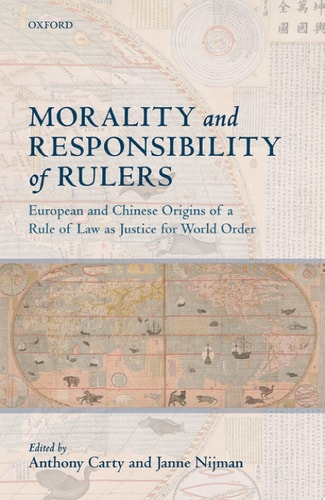
Morality and Responsibility of Rulers: European and Chinese Origins of a Rule of Law as Justice for World Order
0
0
As an Amazon Associate and affiliate partner, Menrva Books earns from qualifying purchases. Learn more
Author Description
The history of ideas on rule of law for world order is a fascinating one, as revealed in this comparative study of both Eastern and Western traditions. This book discerns 'rule of law as justice' conceptions alternative to the positivist conceptions of the liberal internationalist rule of law today.The volume begins by revisiting early-modern European roots of rule of law for world order thinking. In doing so it looks to Northern Humanism and to natural law, in the sense of justice as morally and reasonably ordered self-discipline. Such a standard is not an instrument of external monitoring but of self-reflection and self-cultivation. It then considers whether comparable concepts exist in Chinese thought. Inspired by Confucius and even Laozi, the Chinese official and intellectual elite readily imagined that international law was governed by moral principles similar to their own. A series of case studies then reveals the dramatic change after the East-West encounters from the 1860s until after 1901, as Chinese disillusionment with the Hobbesian positivism of Western international law becomes ever more apparent.What, therefore, are the possibilities of traditional Chinese and European ethical thinking in the context of current world affairs? Considering the obstacles which stand in the way of this, both East and West, this book reaches the conclusion that everything is possible even in a world dominated by state bureaucracies and late capitalist postmodernism. The rational, ethical spirit is universal.
Menrva's Summary
THE THESIS
This book investigates whether traditional European and Chinese ethical frameworks can offer a viable alternative to contemporary positivist conceptions of the rule of law in international affairs. Authors Anthony Carty and Janne E. Nijman utilize historical analysis and comparative legal theory to examine how early-modern European natural law and classical Chinese moral philosophy once conceptualized justice as a form of self-discipline. They argue that these historical perspectives provide a necessary critique of the current Hobbesian-influenced international order, suggesting that a universal ethical spirit remains relevant despite the dominance of modern state bureaucracies.
THE SCOPE MAP
What You Will Find
- Comparative analysis of Northern Humanism and Confucian political thought.
- Historical examination of East-West legal encounters from the 1860s to 1901.
- Critique of Hobbesian positivism within the framework of international law.
- Philosophical exploration of justice as a mechanism for self-cultivation rather than external monitoring.
THE AUTHORITY PERSPECTIVE
Scholars and legal historians identify this work as a significant contribution to the study of non-Western influences on international legal theory. Readers frequently note the academic density of the prose, which requires a foundational understanding of both international law and political philosophy to fully engage with the authors' arguments.
Page Count:
496
Publication Date:
2018-04-15
Publisher:
Oxford University Press
ISBN-10:
0199670056
ISBN-13:
9780199670055
History
Rule Of Law
Comparative Law
Natural law
Law
Ethics
Professional Career & Trade
International Law
Law europe
Political Philosophy
Community Tags
Similar Books