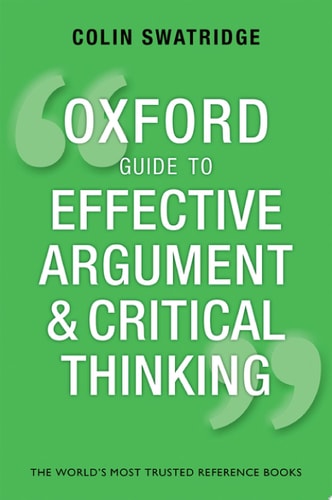
Oxford Guide to Effective Argument and Critical Thinking
0
0
As an Amazon Associate and affiliate partner, Menrva Books earns from qualifying purchases. Learn more
Author Description
How do you approach an essay or discussion question? How do you review what claims others have made and offer counter-claims? And how do you weigh up the strengths and weaknesses of your own argument before putting together a persuasive conclusion?This accessible book takes you step by step through the art of argument, from thinking about what to write and how you might write it, to how you may strengthen your claims, and how to come to a strong conclusion. Engagingly written and featuring useful summaries at the end of each chapter, this new book offers easily transferable practical advice on assessing the arguments of others and putting forward effective arguments of your own. The book's strength lies in its clear guidance and the use of real-life arguments - both contemporary and historical - and real-life essay questions from a variety of disciplines across the humanities and social sciences. These interesting, relevant, and often entertaining, examples are used not to illustrate, but to make essential points about what can be learnt, what techniques can be borrowed, and what pitfalls to avoid in the area of analytical thinking and writing.The Oxford Guide to Effective Argument and Critical Thinking is sure to improve the written work of any student required to demonstrate the key skills of critical writing and thinking. It is equally as valuable for professionals needing these skills (e.g. journalists, lawyers, researchers, politicians) as well as for anyone who has a case to put forward and would like to do so convincingly.
Menrva's Summary
THE THESIS
How can individuals systematically improve their ability to construct persuasive arguments and engage in rigorous critical thinking? Colin Swatridge, an experienced educator, provides a structured framework for evaluating claims and developing counter-arguments. By drawing on examples from the humanities and social sciences, the author demonstrates how to identify logical fallacies and strengthen written conclusions. The text serves as a practical manual for students and professionals seeking to refine their analytical output.
THE SCOPE MAP
What You Will Find
- Step-by-step methodology for drafting essays and discussion responses
- Techniques for assessing the validity of external claims and evidence
- Analysis of historical and contemporary arguments across various disciplines
- Practical strategies for identifying and avoiding common analytical pitfalls
THE AUTHORITY PERSPECTIVE
Experts and educators frequently cite this guide as a foundational resource for students transitioning into higher education. Readers often note the clarity of the prose and the utility of the chapter summaries in reinforcing complex logical concepts.
Page Count:
256
Publication Date:
2014-08-26
Publisher:
Oxford University Press
ISBN-10:
0199671729
ISBN-13:
9780199671724
Logic
Critical thinking
Academic writing
Writing Skills
Communication
Reasoning
Education
Community Tags
Other Editions(3)

Similar Books

Reader Comments
Share Your Thoughts
No comments yet. Be the first to share your thoughts!