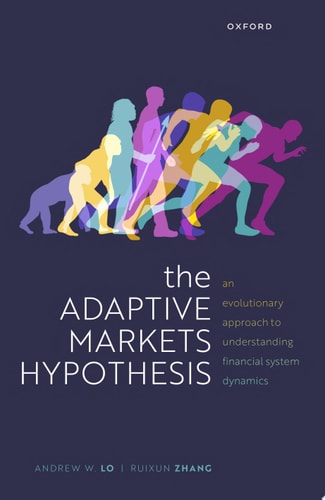
The Adaptive Markets Hypothesis: An Evolutionary Approach to Understanding Financial System Dynamics
0
0
As an Amazon Associate and affiliate partner, Menrva Books earns from qualifying purchases. Learn more
Author Description
The Adaptive Markets Hypothesis (AMH) presents a formal and systematic exposition of a new narrative about financial markets that reconciles rational investor behaviour with periods of temporary financial insanity. In this narrative, intelligent but fallible investors learn from and adapt to randomly shifting environments. Financial markets may not always be efficient, but they are highly competitive, innovative, and adaptive, varying in their degree of efficiency as investor populations and the financial landscape change over time.Andrew Lo and Ruixun Zhang develop the mathematical foundations of the AMH--a simple yet surprisingly powerful set of evolutionary models of behaviour--and then apply these foundations to show how the most fundamental economic behaviours that we take for granted can arise solely through natural selection. Drawing on recent advances in cognitive neuroscience and artificial intelligence, the book also explores how our brain affects economic and financial decision making.The AMH can be applied in many contexts, ranging from designing trading strategies, to managing risk and understanding financial crises, to formulating macroprudential policies to promote financial stability. This volume is a must read for anyone who has ever been puzzled and concerned by the behaviour of financial markets and the implications for their personal wealth, and seeks to learn how best to respond to such behaviour.
Menrva's Summary
THE THESIS
How can the apparent contradiction between rational investor behavior and periods of market irrationality be reconciled through an evolutionary framework? Andrew W. Lo, a professor at the MIT Sloan School of Management, and Ruixun Zhang provide a rigorous academic exposition of the Adaptive Markets Hypothesis (AMH). By integrating principles from evolutionary biology, cognitive neuroscience, and artificial intelligence, the authors argue that financial markets function as complex ecosystems where participants learn and adapt to shifting environments rather than operating under the static assumptions of traditional efficient market theory.
THE SCOPE MAP
What You Will Find
- Mathematical foundations of evolutionary models applied to investor behavior.
- Analysis of how natural selection influences fundamental economic decision-making.
- Integration of cognitive neuroscience and artificial intelligence in financial modeling.
- Practical applications for risk management, trading strategy design, and macroprudential policy formulation.
THE AUTHORITY PERSPECTIVE
Experts recognize this work as a significant contribution to modern financial theory, offering a bridge between classical economics and behavioral finance. Readers frequently note the academic density of the prose, which requires a foundational understanding of quantitative finance to fully grasp the proposed models.
Page Count:
656
Publication Date:
2024-02-09
Publisher:
Oxford University Press
ISBN-10:
0199681147
ISBN-13:
9780199681143
Economics
Finance
Evolutionary Biology
Investment
Market Theory
Community Tags
Similar Books