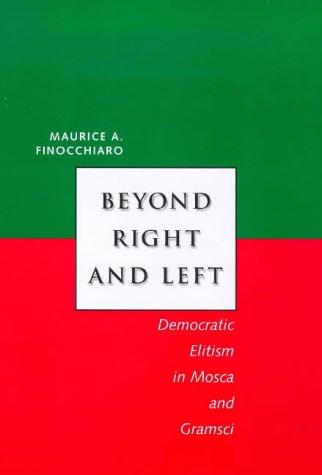
Beyond Right and Left
0
0
As an Amazon Associate and affiliate partner, Menrva Books earns from qualifying purchases. Learn more
Author Description
Two Italian writers, Gaetano Mosca and Antonio Gramsci, have been very influential in twentieth-century political thought, the first cast as a thoroughgoing conservative, the second as the model of a humanistic Marxist. The author of this provocative book, the first systematic study of the connection between the two men, maintains that they are closer to each other than is commonly supposed-that they in fact belong to the same political tradition of democratic elitism. Maurice A. Finocchiaro argues that Gramsci's political theory is a constructive critique of Mosca's and that the key common element is the attempt to combine democracy and elitism in a theoretical system that defines them not as opposite but as compatible and interdependent. Finocchiaro finds that a critical examination of the major works of the two men demonstrates their shared belief in the viability of democratic elitism and undermines the importance of the distinction between right and left.
Menrva's Summary
THE THESIS
This book challenges the conventional understanding of two influential Italian political thinkers, Gaetano Mosca and Antonio Gramsci, by arguing they belong to the same tradition of democratic elitism. Maurice A. Finocchiaro posits that Gramsci's political theory is a direct, constructive critique of Mosca's, with their shared core being the attempt to reconcile democracy and elitism. The author contends that these concepts are not opposing forces but are, in fact, compatible and interdependent within a theoretical framework. A close examination of their major works reveals a common belief in the feasibility of democratic elitism, thereby diminishing the significance of the traditional left-right political spectrum.
THE SCOPE MAP
- A comparative analysis of the political thought of Gaetano Mosca and Antonio Gramsci.
- An argument for their shared intellectual tradition of democratic elitism.
- An examination of Gramsci's political theory as a critique of Mosca's.
- An exploration of the compatibility and interdependence of democracy and elitism.
- A deconstruction of the traditional distinction between the political right and left.
- Analysis of major works by both Mosca and Gramsci.
THE AUTHORITY PERSPECTIVE
This book is likely to be of interest to scholars and students of political theory, Italian intellectual history, and the history of ideas. The author's argument that Mosca and Gramsci are closer than commonly supposed, belonging to a shared tradition of democratic elitism, offers a novel perspective that challenges established classifications. By focusing on their shared belief in the viability of democratic elitism, the book aims to reframe the understanding of their contributions and the broader political landscape they inhabited. The work promises a rigorous examination of their major texts to support its central thesis.
Page Count:
302
Publication Date:
1999-01-01
ISBN-10:
0300075359
History
Politics
Philosophy
Science
Non-Fiction
History of Ideas
Conservatism
Marxism
Political Theory
Community Tags
Similar Books