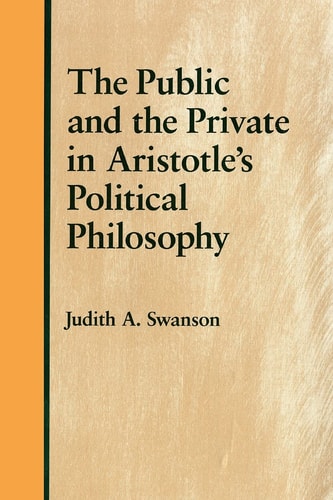
The Public and the Private in Aristotle's Political Philosophy
0
0
As an Amazon Associate and affiliate partner, Menrva Books earns from qualifying purchases. Learn more
Author Description
Aristotle offers a conception of the private and its relationship to the public that suggests a remedy to the limitations of liberalism today, according to Judith A. Swanson. In this fresh and lucid interpretation of Aristotle's political philosophy, Swanson challenges the dominant view that he regards the private as a mere precondition to the public. She argues, rather, that for Aristotle private activity develops virtue and is thus essential both to individual freedom and happiness and to the well-being of the political order. Swanson presents an innovative reading of The Politics which revises our understanding of Aristotle's political economy and his views on women and the family, slavery, and the relation between friendship and civic solidarity. She examines the private activities Aristotle considers necessary to a complete human life—maintaining a household, transacting business, sustaining friendships, and philosophizing. Focusing on ways Aristotle's public invests in the private through law, rule, and education, she shows how the public can foster a morally and intellectually virtuous citizenry. In contrast to classical liberal theory, which presents privacy as a shield of rights protecting individuals from one another and from the state, for Aristotle a regime can attain self-sufficiency only by bringing about a dynamic equilibrium between the public and the private. The Public and the Private in Aristotle's Political Philosophy will be essential reading for scholars and students of political philosophy, political theory, classics, intellectual history, and the history of women.
Menrva's Summary
THE THESIS
This book investigates the relationship between the private sphere and the public realm in Aristotle's political philosophy. Judith A. Swanson presents a novel interpretation of Aristotle, challenging the common view that he considered the private merely a precursor to the public. She argues that private activities are crucial for developing virtue, which in turn is essential for individual freedom, happiness, and the overall well-being of the political order. The work re-examines Aristotle's political economy, his views on women, family, slavery, and the connection between friendship and civic solidarity, proposing that a regime achieves self-sufficiency through a dynamic balance between public and private life.
THE SCOPE MAP
- Analysis of Aristotle's conception of the private sphere and its essential role in developing virtue.
- Reinterpretation of Aristotle's views on the political economy, family, and women.
- Examination of private activities such as household management, business, friendship, and philosophizing.
- Exploration of how the public sphere, through law, rule, and education, invests in and fosters private virtue.
- Contrast between Aristotle's view of the public-private dynamic and classical liberal theory.
- Discussion on the relationship between friendship and civic solidarity in Aristotelian thought.
- Argument for a dynamic equilibrium between public and private as key to a self-sufficient regime.
THE AUTHORITY PERSPECTIVE
Judith A. Swanson's interpretation of Aristotle's political philosophy offers a fresh perspective on the relationship between the public and private spheres, suggesting a potential remedy for contemporary liberal limitations. The book challenges dominant scholarly views by emphasizing the essential role of private activity in cultivating virtue, thereby contributing to both individual flourishing and the health of the political community. It is expected to be a significant contribution for scholars and students across political philosophy, political theory, classics, intellectual history, and the history of women.
Page Count:
264
Publication Date:
2019-03-15
Publisher:
Cornell University Press
ISBN-10:
1501740849
ISBN-13:
9781501740848
Non-Fiction
Philosophy
Social Theory
Political Philosophy
Public Policy
History of Ideas
Gender Studies
Ancient Greece
Classical Philosophy
Feminist Theory
Political Theory
Aristotle
Community Tags
Other Editions(2)
Similar Books