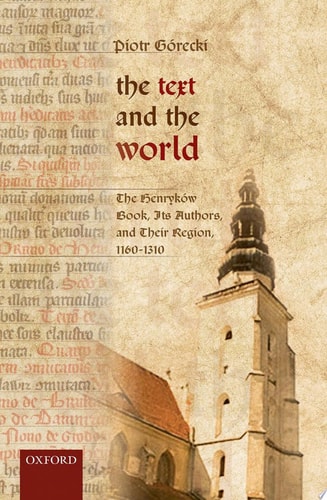
The Text and the World: The Henrykow Book, Its Authors, and Their Region, 1160-1310
0
0
As an Amazon Associate and affiliate partner, Menrva Books earns from qualifying purchases. Learn more
Author Description
The Text and the World is a study of an exceptionally interesting primary source - the Henrykow Book - and of the local and regional world which that source reflected and helped shape. The source is a history of the Cistercian monastery in Henrykow, about forty kilometers to the south of Wroclaw, in the duchy of Silesia, produced in the monastery in two sections-one completed soon after 1268, the other soon after 1310-and redacted into a single codex in the second or third decade of the fourteenth century. The earlier part of the Book is the work of Peter, the third abbot of the monastery, while the continuation was written by an anonymous monk at the same community, possibly a later abbot by the same name.The Henrykow Book offers an exceptionally rich introduction to a number of subjects currently of major interest to medieval historians. It is interesting as a literary work, as an instance of forensic rhetoric, and as a type of legal argument; as an instance of biography and (implicit) autobiography. It draws on and is an example of the relationship between memory and writing, and acts as a record of lordship, power, economy, the law, social groups, communities, and institutions, in the local and regional world of the time. The Text and the World explores each of these major subjects, contextualized with the Henrykow Book's contemporary diplomatic evidence.
Menrva's Summary
THE THESIS
This study investigates how the Henrykow Book, a thirteenth-century Cistercian monastic chronicle, functions as both a literary artifact and a primary source for understanding the socio-political landscape of medieval Silesia. Piotr Górecki, a specialist in medieval European history, utilizes this codex to examine the intersection of memory, lordship, and legal practice in the region between 1160 and 1310. By contextualizing the text against contemporary diplomatic records, the author argues that the chronicle serves as a deliberate instrument of institutional power and social identity. The work provides a rigorous framework for interpreting how monastic communities documented their own history to justify their economic and legal standing.
THE SCOPE MAP
What You Will Find
- Analysis of the two-part composition of the Henrykow Book, written by Abbot Peter and his successor.
- Examination of the relationship between oral memory, written record, and forensic rhetoric in monastic documentation.
- Investigation into the social structures, land tenure, and institutional power dynamics of the duchy of Silesia.
- Comparative study of the chronicle alongside regional diplomatic evidence and legal charters.
THE AUTHORITY PERSPECTIVE
Historians and medievalists frequently cite this work as a foundational analysis of the Henrykow Book, noting its meticulous attention to the intersection of literary form and historical reality. Scholars highlight the text for its dense, scholarly prose and its ability to bridge the gap between micro-history and broader regional trends in medieval Europe.
Page Count:
320
Publication Date:
2015-09-09
Publisher:
Oxford University Press
ISBN-10:
0199688796
ISBN-13:
9780199688791
History
European History
Europe
Church Lands
Monasticism
Historiography
Silesia
Community Tags
Similar Books