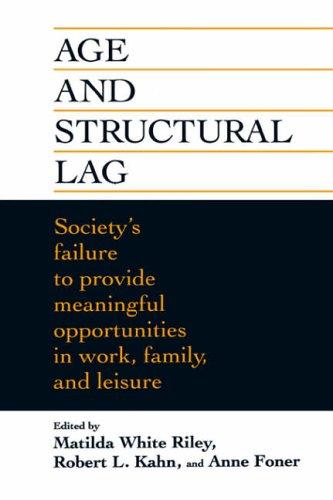
Age and Structural Lag
0
0
As an Amazon Associate and affiliate partner, Menrva Books earns from qualifying purchases. Learn more
Author Description
In twentieth-century industrial societies most of us live longer and healthier lives than ever before in history. Yet the social structures and institutions that provide opportunities for our lives are still marked by age constraints that were appropriate a century ago. Education is still primarily reserved for the young; work and family responsibilities are crowded into the middle years; while leisure and free time are allocated to the added decades of retirement. Even the many vital men and women past age 65, or even 55, who want or need paid jobs are regarded as "too old" to work. Lives have changed, but social structures have not caught up. There is a lag or mismatch between lives and structures.. What are the detrimental consequences of this structural lag for individuals and society at large? How do structures change, and how can they be changed to enhance lives at every age? What alternative structures would lessen the burdens of middle age, prepare children for the complexities of the real world, and provide opportunities for productivity, independence, and esteem for older people? Seeking answers to such questions, the twelve chapters in this book bring powerful insights to bear on structural lag from sociology and psychology; and they draw upon history, anthropology, and economics to disclose new perspectives on the past and the present, and new hope for the future. While special attention is paid to structures affecting the old, issues relating to all ages are explored in respect to work, family, education, retirement, and other domains of social life. This is a powerful book, revolutionary in its conceptions and implications, calling for structural changes in society; a new mix of work, family, and leisure. Opening a critical but neglected area, it is the first book publication of a long-range Program on Age and Structural Change (PASC) directed by Matilda White Riley at the National Institute on Aging and involving an international network of scholar
Menrva's Summary
THE THESIS
The central problem this book investigates is the mismatch between rapidly changing human lifespans and static social structures. Matilda White Riley, a leading sociologist, examines how societal institutions like education, work, and retirement remain anchored to age constraints from a century ago, despite people living longer and healthier lives. The book explores the detrimental consequences of this
THE SCOPE MAP
- Analysis of age-based constraints in education, work, family responsibilities, and retirement.
- Examination of the societal and individual consequences of structural lag.
- Exploration of how social structures change and how they can be altered to better serve all age groups.
- Insights from sociology, psychology, history, anthropology, and economics.
- Discussion of alternative structures that could enhance productivity, independence, and esteem for older individuals.
- Focus on issues relating to all ages within the context of work, family, and education.
THE AUTHORITY PERSPECTIVE
This book is presented as a foundational text from the Program on Age and Structural Change (PASC), directed by Matilda White Riley. It is described as revolutionary in its conceptions and implications, calling for significant structural changes in society to better align institutions with extended lifespans. The work is noted for opening a critical but neglected area of study, drawing on multiple disciplines to offer new perspectives on aging and social structures. Its implications suggest a need for a reevaluation of how work, family, and leisure are structured across the lifespan.
Page Count:
290
Publication Date:
1994-01-01
ISBN-10:
0471016780
Economics
History
Non-Fiction
Sociology
Social change
Demographics
Gerontology
Community Tags
Similar Books