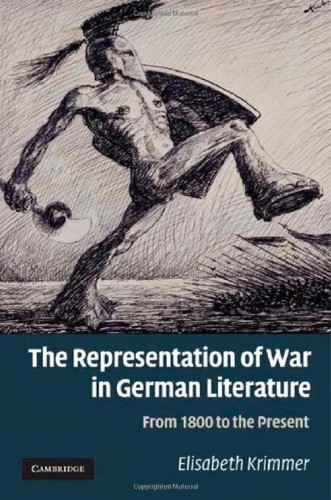
The Representation of War in German Literature
0
0
As an Amazon Associate and affiliate partner, Menrva Books earns from qualifying purchases. Learn more
Author Description
The history of literature about war is marked by a fundamental paradox: although war forms the subject of countless novels, dramas, poems, and films, it is often conceived as indescribable. Even as many writers strive towards an ideal of authenticity, they maintain that no representation can do justice to the terror and violence of war. Readings of Schiller, Kleist, Jünger, Remarque, Grass, Böll, Handke, and Jelinek reveal that stylistic and aesthetic features, gender discourses, and concepts of agency and victimization can all undermine a text's martial stance or its ostensible pacifist agenda. Spanning the period from the Revolutionary and Napoleonic Wars to the recent wars in Yugoslavia and Iraq, Elisabeth Krimmer investigates the aesthetic, theoretical, and historical challenges that confront writers of war
Menrva's Summary
THE THESIS
The representation of war in German literature grapples with the inherent paradox of depicting the indescribable. Elisabeth Krimmer, drawing on her expertise in German literature and cultural studies, examines how writers have approached the subject of war, from the Napoleonic era to contemporary conflicts. Through close readings of prominent authors such as Schiller, Kleist, Jünger, Remarque, Grass, Böll, Handke, and Jelinek, the book analyzes how stylistic choices, gender perspectives, and notions of agency and victimhood complicate both pro-war and pacifist stances. Krimmer investigates the complex interplay between aesthetic representation, theoretical challenges, and historical context in German war literature.
THE SCOPE MAP
- Analysis of literary works from the Revolutionary and Napoleonic Wars to the Yugoslav and Iraq Wars.
- Examination of key German authors including Schiller, Kleist, Jünger, Remarque, Grass, Böll, Handke, and Jelinek.
- Investigation into how stylistic and aesthetic features influence the portrayal of war.
- Exploration of gender discourses and their impact on martial or pacifist themes.
- Discussion of concepts of agency and victimization within war narratives.
- Analysis of the theoretical and historical challenges faced by writers of war literature.
- Focus on the fundamental paradox of war being conceived as indescribable despite its frequent depiction.
THE AUTHORITY PERSPECTIVE
This scholarly work is likely to be regarded as a significant contribution to the study of war literature, offering a nuanced perspective on German literary responses to conflict. The detailed analysis of canonical authors and historical periods suggests a text aimed at academics and students of literature, history, and cultural studies. Its exploration of the paradox of representing war indicates a critical engagement with both aesthetic theory and historical context, providing a comprehensive overview of the subject.
Page Count:
0
Publication Date:
2010-01-01
ISBN-10:
052119802X
ISBN-13:
9780521198028
History
Non-Fiction
War Studies
Literary Criticism
Community Tags
Similar Books