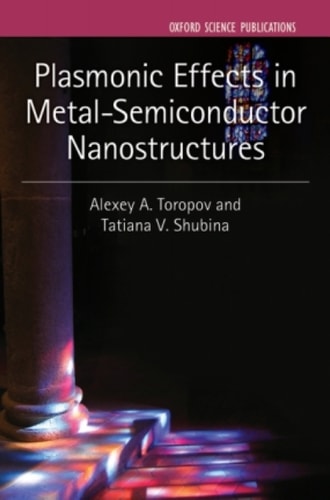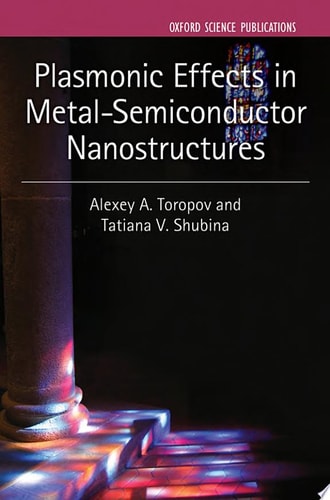
Plasmonic Effects in Metal-Semiconductor Nanostructures
0
0
As an Amazon Associate and affiliate partner, Menrva Books earns from qualifying purchases. Learn more
Author Description
Metal-semiconductor nanostructures represent an important new class of materials employed in designing advanced optoelectronic and nanophotonic devices, such as plasmonic nanolasers, plasmon-enhanced light-emitting diodes and solar cells, plasmonic emitters of single photons, and quantum devices operating in infrared and terahertz domains. The combination of surface plasmon resonances in conducting structures, providing strong concentration of an electromagnetic optical field nearby, with sharp optical resonances in semiconductors, which are highly sensitive to external electromagnetic fields, creates a platform to control light on the nanoscale. The design of the composite metal-semiconductor system imposes the consideration of both the plasmonic resonances in metal and the optical transitions in semiconductors - a key issue being their resonant interaction providing a coupling regime.In this book the reader will find descriptions of electrodynamics of conducting structures, quantum physics of semiconductor nanostructures, and guidelines for advanced engineering of metal-semiconductor composites. These constituents form together the physical basics of the metal-semiconductor plasmonics, underlying many effective practical applications. The list of covered topics also includes the review of recent results, such as the achievement of a strong coupling regime, and the preservation of non-classical statistics of photons in plasmonic cavities combined with semiconductor nanostructures.
Menrva's Summary
THE THESIS
This book investigates the physical principles and engineering challenges involved in the resonant interaction between surface plasmons in metal structures and optical transitions in semiconductor nanostructures. Authors Alexey A. Toropov and Tatiana V. Shubina synthesize electrodynamics and quantum physics to establish a framework for controlling light at the nanoscale. By examining the coupling regimes of these composite systems, the text provides a theoretical and practical foundation for developing next-generation optoelectronic devices.
THE SCOPE MAP
What You Will Find
- Electrodynamics of conducting structures and surface plasmon resonances.
- Quantum physics of semiconductor nanostructures and their optical transitions.
- Engineering guidelines for designing metal-semiconductor composite systems.
- Analysis of the strong coupling regime and non-classical photon statistics in plasmonic cavities.
THE AUTHORITY PERSPECTIVE
Experts identify this work as a specialized resource for researchers and graduate students focusing on nanophotonics and semiconductor physics. Readers frequently note the high level of technical density, which requires a strong background in quantum mechanics and electromagnetism to fully utilize the provided engineering guidelines.
Page Count:
400
Publication Date:
2015-06-09
Publisher:
Oxford University Press
ISBN-10:
0199699313
ISBN-13:
9780199699315
Science
Semiconductors
Engineering
Nanostructures
Physics
Nanotechnology