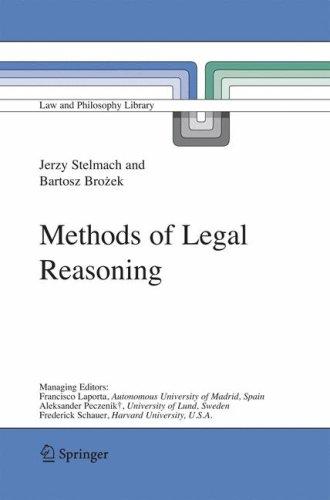
Methods of Legal Reasoning
0
0
As an Amazon Associate and affiliate partner, Menrva Books earns from qualifying purchases. Learn more
Author Description
The book attempts to describe and criticize four methods used in legal practice, legal dogmatics and legal theory: logic, analysis, argumentation and hermeneutics. Apart from a presentation of basic ideas connected with the above mentioned methods, the essays contained in this book seek to answer questions concerning the assumptions standing behind these methods, the limits of using them and their usefulness in the practice and theory of law. A specific feature of the book is that in one study four different, sometimes competing concepts of legal method are discussed. The panorama, sketched like this, allows one to reflect deeply on the questions concerning the methodological conditioning of legal science and the existence of a unique, specific legal method. The authors argue that there exists no such method. They claim that the methodologies presented in the book may serve as a basis for constructing a coherent and useful conception of legal thinking. Any such conception, however, must recognize its own assumptions and limitations, resulting from adopting a specific philosophical stance.
Menrva's Summary
THE THESIS
This book critically examines four fundamental methods employed in legal practice, theory, and dogmatics. It presents the core ideas of logic, analysis, argumentation, and hermeneutics, while also probing the underlying assumptions, inherent limitations, and practical utility of each approach. The work uniquely discusses these often-competing concepts within a single volume, fostering deep reflection on the methodological underpinnings of legal science. Ultimately, the authors contend that a singular, specific legal method does not exist, but that these presented methodologies can form the basis for a coherent legal thinking framework, provided its philosophical assumptions and limitations are acknowledged.
THE SCOPE MAP
- Detailed exposition of logical methods in legal reasoning.
- Analysis of analytical approaches within legal scholarship.
- Exploration of argumentation techniques in law.
- Examination of hermeneutics as a legal interpretative tool.
- Discussion of the assumptions and limitations of each method.
- Assessment of the usefulness of these methods in legal practice and theory.
- Comparative analysis of competing legal methodologies.
- Consideration of the methodological conditioning of legal science.
THE AUTHORITY PERSPECTIVE
The book offers a comprehensive critique of established legal reasoning methods, presenting a panorama of competing concepts. It aims to stimulate deep reflection on the methodological foundations of legal science and the existence of a unique legal method. The authors' argument that no single method exists, but that various approaches can form a coherent framework when their limitations are recognized, provides a nuanced perspective. This work is likely to be of interest to legal scholars, theorists, and practitioners seeking to understand the philosophical underpinnings and practical constraints of legal thought.
Page Count:
244
Publication Date:
2011-01-01
ISBN-10:
9048172322
ISBN-13:
9789048172320
Non-Fiction
Philosophy
Science
Legal Theory
Law
Community Tags
Similar Books