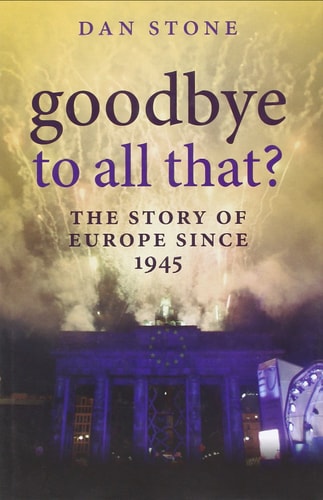
Goodbye to All That: The Story of Europe Since 1945
0
0
As an Amazon Associate and affiliate partner, Menrva Books earns from qualifying purchases. Learn more
Author Description
In the decade after 1945, as the Cold War freeze set in, a new Europe slowly began to emerge from the ruins of the Second World War, based on a broad rejection of the fascist past that had so scarred the continent's recent history. In the East, this new consensus was enforced by Soviet-imposed Communist regimes. In the West, the process was less coercive, amounting more to a consensus of silence. On both sides, much was deliberately forgotten or obscured.The years which followed were in many ways golden years for western Europe. Democracy became embedded in Germany, and eventually triumphed over dictatorship in Spain, Portugal, and Greece. Britain and France faced up to the necessity of decolonization. The European Economic Community was founded and went from strength to strength, as the economies of western Europe bounced back from the devastation of the war. The countries of the East lagged far behind and seemed caught in a perpetual game of catch-up, but even there conditions had improved since the end of the war, albeit at a much slower rate. Above all, throughout this period the European world continued to be sustained by the broad anti-fascist consensus that had emerged in the years after 1945.However, as Dan Stone shows in this new history of the continent since the war, this fundamental consensus began to break down in the wake of the oil shocks of the 1970s, a process which has rapidly accelerated since the end of the Cold War. Globalization, deregulation, and the erosion of social-democratic welfare capitalism in the West, and the collapse of the purported Communist alternative in the East, have all fatally undermined the post-war anti-fascist value system that predominated across Europe in the first four decades after the end of the Second World War.Ominously, this has been accompanied by a rise in right-wing populism and a widespread revision of the anti-fascist narrative on which this value system was based. The danger of this shift is now evident: fina
Menrva's Summary
THE THESIS
This book investigates the collapse of the post-1945 anti-fascist consensus in Europe and the subsequent rise of right-wing populism and historical revisionism. Dan Stone, a professor of modern history, utilizes a broad range of political and economic data to argue that the stability of the post-war era was predicated on a shared rejection of fascism that has been fatally undermined by globalization and the erosion of social-democratic structures. He traces the evolution of the continent from the reconstruction period through the oil shocks of the 1970s to the current era of political fragmentation.
THE SCOPE MAP
What You Will Find
- Analysis of the post-war reconstruction period in both Western and Eastern Europe.
- Examination of the economic shifts caused by the 1970s oil shocks and subsequent deregulation.
- Evaluation of the decline of the anti-fascist value system across the continent.
- Discussion of the rise of right-wing populism and the revision of historical narratives.
THE AUTHORITY PERSPECTIVE
Historians and political analysts recognize this work as a comprehensive synthesis of contemporary European political evolution. Readers frequently note the clarity of Stone's prose in navigating complex geopolitical shifts and the urgency of his warnings regarding current democratic instability.
Page Count:
480
Publication Date:
2014-03-28
Publisher:
Oxford University Press
ISBN-10:
019969771X
ISBN-13:
9780199697717
History
Cold War
European History
Community Tags
Similar Books