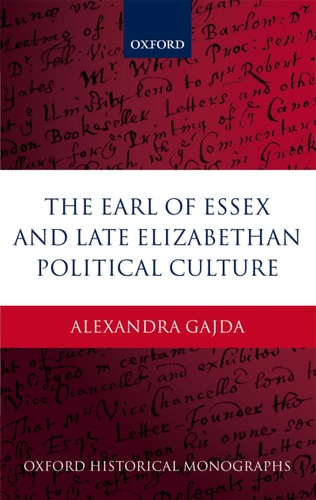
The Earl of Essex and Late Elizabethan Political Culture
0
0
As an Amazon Associate and affiliate partner, Menrva Books earns from qualifying purchases. Learn more
Author Description
In sixteenth-century England Robert Devereux, 2nd earl of Essex, enjoyed great domestic and international renown as a favourite of Elizabeth I. He was a soldier and a statesman of exceptionally powerful ambition. After his disastrous uprising in 1601 Essex fell from the heights of fame and favour, and ended his life as a traitor on the scaffold. This interdisciplinary account of the political culture of late Elizabethan England explores the ideological contexts of Essex's extraordinary career and fall from grace, and the intricate relationship between thought and action in Elizabethan England.By the late sixteenth century, fundamental political models and vocabularies that were employed to legitimise the Elizabethan polity were undermined by the strains of war, the ambivalence that many felt towards the church, continued uncertainty over the succession, and the perceived weaknesses of the rule of the aging Elizabeth. Essex's career and revolt threw all of these strains into relief. Alexandra Gajda examines the attitude of the earl and his followers to war, religion, the structures of the Elizabethan polity, and Essex's role within it. She also explores the classical and historical scholarship prized by Essex and his associates that gave shape and meaning to the earl's increasingly fractured relationship with the Queen and regime. She addresses contemporary responses to the earl, both positive and negative, and the earl's wider impact on political culture. Political and religious ideas in late sixteenth-century England had an important impact on political events in early modern England, and played a vital role in shaping the rise and fall of Essex's career.
Menrva's Summary
THE THESIS
This work investigates how the political career and eventual rebellion of Robert Devereux, 2nd Earl of Essex, served as a catalyst for exposing the underlying ideological fractures within late Elizabethan England. Alexandra Gajda, a scholar of early modern history, utilizes a combination of political theory, classical scholarship, and contemporary primary sources to analyze the intersection of intellectual life and state action. The book argues that the tensions surrounding war, religion, and the succession crisis were not merely external pressures but were deeply embedded in the political vocabulary and cultural framework of the era. By examining the Earl's own intellectual circle, Gajda demonstrates how classical and historical models were used to justify both the support for and the eventual opposition to the Elizabethan regime.
THE SCOPE MAP
What You Will Find
- An analysis of the ideological contexts of late sixteenth-century English political culture.
- A study of the classical and historical scholarship utilized by Essex and his associates to interpret their political environment.
- Examination of the impact of war, religious ambivalence, and succession uncertainty on the stability of the Elizabethan polity.
- An interdisciplinary assessment of the relationship between political thought and the practical actions of the Earl of Essex.
THE AUTHORITY PERSPECTIVE
Historians and scholars of the Tudor period frequently cite this monograph as a rigorous examination of the intellectual climate surrounding the Essex rebellion. Readers often note the academic density of the prose, which provides a sophisticated look at the intersection of political theory and historical event.
Page Count:
336
Publication Date:
2012-05-04
Publisher:
Oxford University Press
ISBN-10:
0199699682
ISBN-13:
9780199699681
History
Biography
Community Tags
Other Editions(2)
Similar Books