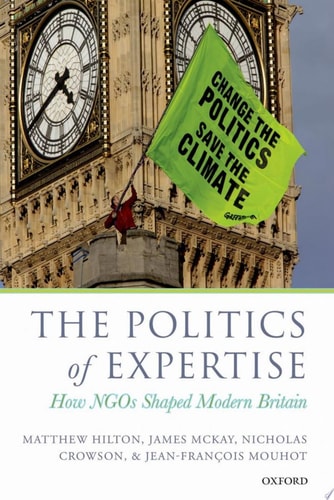
The Politics of Expertise: How NGOs Shaped Modern Britain
0
0
As an Amazon Associate and affiliate partner, Menrva Books earns from qualifying purchases. Learn more
Author Description
The Politics of Expertise offers a challenging new interpretation of politics in contemporary Britain, through an examination of non-governmental organisations. Using specific case studies of the homelessness, environment, and international aid and development sectors, it demonstrates how politics and political activism has changed over the last half century.NGOs have contributed enormously to a professionalization and a privatization of politics, emerging as a new form of expert knowledge and political participation. They have been led by a new breed of non-party politician, working in collaboration and in competition with government. Skilful navigators of the modern technocratic state, they have brought expertise to expertise and, in so doing, have changed the nature of grassroots activism. As affluent citizens have felt marginalised by the increasingly complex nature of many policy solutions, they have made the rational calculation to support NGOs, the professionalism and resources of which make them better able to tackle complex problems. Yet in doing so, support rather than participation becomes the more appropriate way to describe the relationship of the public to NGOs. As voter turnout has declined, membership and trust in NGOs has increased. But NGOs are very different types of organisations from the classic democratic institutions of political parties and the labour movement. They maintain different and varied relationships with the publics they seek to represent. Attracting mass support has provided them with the resources and the legitimacy to speak to power on a bewildering range of issues, yet perhaps the ultimate victors in this new form of politics are the NGOs themselves.
Menrva's Summary
THE THESIS
This work investigates how the rise of non-governmental organisations has fundamentally altered the landscape of political participation and governance in contemporary Britain. The authors, a team of academic historians and political researchers, utilize a framework of professionalization and privatization to argue that NGOs have replaced traditional democratic institutions as the primary mediators between the public and the state. By analyzing the shift from grassroots activism to technocratic advocacy, the text posits that the modern political relationship is defined more by citizen support than by direct participation.
THE SCOPE MAP
What You Will Find
- Analysis of the homelessness, environment, and international aid sectors in Britain over the last fifty years.
- Examination of the professionalization of political activism and the emergence of non-party politicians.
- Case studies detailing the collaborative and competitive dynamics between NGOs and the state.
- Evaluation of the decline in traditional party membership alongside the rise of NGO trust and influence.
THE AUTHORITY PERSPECTIVE
Scholars and political analysts frequently cite this text as a critical examination of the shift toward technocratic governance in the United Kingdom. Experts highlight the authors' rigorous approach to institutional history as a foundational resource for understanding the changing nature of modern political legitimacy.
Page Count:
336
Publication Date:
2013-06-10
Publisher:
Oxford University Press
ISBN-10:
0199691878
ISBN-13:
9780199691876
Non-Fiction
Politics
History
Non-governmental organizations
Great Britain
Sociology
British History
Community Tags
Similar Books