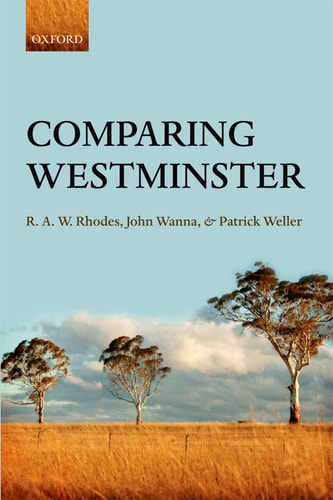
Comparing Westminster
0
0
As an Amazon Associate and affiliate partner, Menrva Books earns from qualifying purchases. Learn more
Author Description
Comparing Westminster explores how the governmental elites in Australia, Britain, Canada, New Zealand, and South Africa understand their Westminster system. It examines in detail four interrelated features of Westminster systems. Firstly, the increasing centralization in collective, responsible cabinet government. Second, the constitutional convention of ministerial and collective responsibility. Third, the role of a professional, non-partisan public service. And finally, parliament's relationship to the executive. The authors explain the changes that have occured in the Westminster model by analyzing four traditions: royal prerogative, responsible government, constitutional bureaucracy, and representative government. They suggest that each tradition has a recurring dilemma, between centralization and decentralization, party government and ministerial responsibility, professionalization and politicization, and finally elitism and participation. They gone on to argue that these dilemmas recur in four present-day debates: the growth of prime ministerial power, the decline in individual and collective ministerial accountability, politicisation of the public service, and executive dominance of the legislature.Comparing Westminster concludes by identifying five meanings of--or narratives about--Westminster. Firstly, 'Westminster as heritage'--elite actors' shared governmental narrative understood as both precedents and nostalgia. Second, 'Westminster as political tool'--the expedient cloak worn by governments and politicians to defend themselves and criticize opponents. Third, 'Westminster as legitimising tradition'--providing legitimacy and a context for elite actions, serving as a point of reference to navigate this uncertain world. Fourth, 'Westminster as institutional category'--it remains a useful descriptor of a loose family of governments with shared origins and characteristics. Finally, 'Westminster as an effective political system'--it is a more effective and ef
Menrva's Summary
THE THESIS
This book investigates how governmental elites across five nations interpret and adapt the traditional Westminster system of governance in the face of modern political pressures. The authors, a team of distinguished political scientists, utilize a comparative framework to analyze how historical traditions—such as royal prerogative and responsible government—clash with contemporary demands for centralization and executive power. By examining the experiences of Australia, Britain, Canada, New Zealand, and South Africa, the text provides a rigorous analysis of the evolving nature of parliamentary democracy and the recurring dilemmas faced by those in power.
THE SCOPE MAP
What You Will Find
- Comparative analysis of governmental structures in Australia, Britain, Canada, New Zealand, and South Africa.
- Examination of four core traditions: royal prerogative, responsible government, constitutional bureaucracy, and representative government.
- Analysis of recurring political dilemmas including centralization versus decentralization and professionalization versus politicization.
- Identification of five distinct narratives regarding the current utility and meaning of the Westminster model.
THE AUTHORITY PERSPECTIVE
Scholars and political analysts frequently cite this work as a foundational text for understanding the nuances of parliamentary systems in the modern era. The prose is noted for its academic rigor and its ability to synthesize complex institutional history into a coherent framework for comparative study.
Page Count:
288
Publication Date:
2011-09-02
Publisher:
Oxford University Press
ISBN-10:
019969558X
ISBN-13:
9780199695584
History
Great Britain
Canada
New Zealand
Comparative Politics
South Africa
Australia
Government
Representative government and representation
Comparative Government
Public Administration
Community Tags
Similar Books






Reader Comments
Share Your Thoughts
No comments yet. Be the first to share your thoughts!