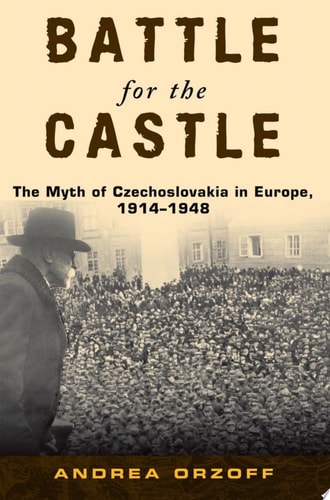
Battle for the Castle
0
0
As an Amazon Associate and affiliate partner, Menrva Books earns from qualifying purchases. Learn more
Author Description
After World War I, diplomats and leaders at the Paris Peace talks redrew the map of Europe, carving up ancient empires and transforming Europe's eastern half into new nation-states. Drawing heavily on the past, the leaders of these young countries crafted national mythologies and deployed them at home and abroad. Domestically, myths were a tool for legitimating the new state with fractious electorates. In Great Power capitals, they were used to curry favor and to compete with the mythologies and propaganda of other insecure postwar states. The new postwar state of Czechoslovakia forged a reputation as Europe's democratic outpost in the East, an island of enlightened tolerance amid an increasingly fascist Central and Eastern Europe. In Battle for the Castle, Andrea Orzoff traces the myth of Czechoslovakia as an ideal democracy. The architects of the myth were two academics who had fled Austria-Hungary in the Great War's early years. Tomáš Garrigue Masaryk, who became Czechoslovakia's first president, and Edvard Beneš, its longtime foreign minister and later president, propagated the idea of the Czechs as a tolerant, prosperous, and cosmopolitan people, devoted to European ideals, and Czechoslovakia as a Western ally capable of containing both German aggression and Bolshevik radicalism. Deeply distrustful of Czech political parties and parliamentary leaders, Beneš and Masaryk created an informal political organization known as the Hrad or Castle. This powerful coalition of intellectuals, journalists, businessmen, religious leaders, and Great War veterans struggled with parliamentary leaders to set the country's political agenda and advance the myth. Abroad, the Castle wielded the national myth to claim the attention and defense of the West against its increasingly hungry neighbors. When Hitler occupied the country, the mythic Czechoslovakia gained power as its leaders went into wartime exile. Once Czechoslovakia regained its independence after 1945, the Castle myth remained a potent force in shaping the nation's identity.
Menrva's Summary
THE THESIS
This book investigates how the leaders of the newly formed Czechoslovakia constructed and utilized a national mythology to secure international legitimacy and domestic stability in the volatile interwar period. Andrea Orzoff, a historian specializing in Central European politics, utilizes primary source documents, diplomatic archives, and contemporary political writings to analyze the creation of the 'Castle'—an informal, elite political network led by Tomáš Garrigue Masaryk and Edvard Beneš. The work argues that this myth of Czechoslovakia as a democratic, tolerant, and Western-aligned outpost was a calculated strategic instrument designed to navigate the geopolitical pressures of the early twentieth century.
THE SCOPE MAP
What You Will Find
- An analysis of the post-World War I geopolitical restructuring of Eastern Europe.
- A detailed examination of the 'Hrad' or 'Castle' political network and its influence on state policy.
- Historical evidence drawn from diplomatic correspondence, propaganda materials, and internal political records.
- An exploration of how national identity is manufactured and deployed to manage both domestic dissent and international relations.
THE AUTHORITY PERSPECTIVE
Historians and political scientists frequently cite this work as a rigorous examination of the intersection between state-building and public relations in the twentieth century. Scholars note the clarity with which Orzoff dissects the mechanisms of political myth-making during the collapse of empires.
Page Count:
308
Publication Date:
2009-01-01
Publisher:
Oxford University Press
ISBN-10:
0199709955
ISBN-13:
9780199709953
History
Czechoslovakia
European History
Diplomatic History
Nationalism
Community Tags
Similar Books