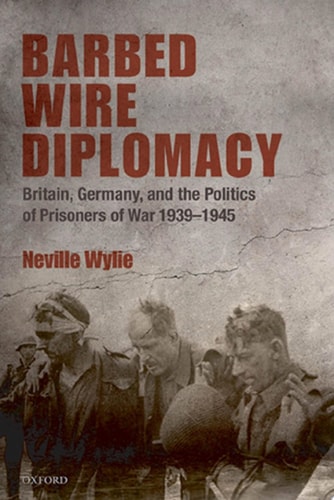
Barbed Wire Diplomacy: Britain, Germany, and the Politics of Prisoners of War 1939-1945
0
0
As an Amazon Associate and affiliate partner, Menrva Books earns from qualifying purchases. Learn more
Author Description
Barbed Wire Diplomacy examines how the United Kingdom government went about protecting the interests, lives and well-being of its prisoners of war (POWs) in Nazi Germany between 1939 and 1945. The comparatively good treatment of British prisoners in Germany has largely been explained by historians in terms of rational self-interest, reciprocity, and influence of Nazi racism, which accorded Anglo-Saxon servicemen a higher status than other categories of POWs. By contrast, Neville Wylie offers a more nuanced picture of Anglo-German relations and the politics of prisoners of war. Drawing on British, German, United States and Swiss sources, he argues that German benevolence towards British POWs stemmed from London's success in working through neutral intermediaries, notably its protecting power (the United States and Switzerland) and the International Committee of the Red Cross, to promote German compliance with the 1929 Geneva convention, and building and sustaining a relationship with the German government that was capable of withstanding the corrosive effects of five years of warfare. Expanding our understanding of both the formulation and execution of POW policy in both capitals, the book sheds new light on the dynamics in inter-belligerent relations during the war. It suggests that while the Second World War should be rightly acknowledged as a conflict in which traditional constraints were routinely abandoned in the pursuit of political, strategic and ideological goals, in this important area of Anglo-German relations, customary international norms were both resilient and effective.
Menrva's Summary
THE THESIS
This work investigates how the United Kingdom managed the protection and treatment of its prisoners of war held in Nazi Germany during the Second World War. Neville Wylie, a scholar of international relations and history, utilizes a multi-archival approach to challenge the conventional narrative that British POW treatment was solely a result of Nazi racial ideology or simple reciprocity. He argues that the relative stability of prisoner conditions was instead the product of persistent diplomatic engagement through neutral intermediaries and the active promotion of the 1929 Geneva Convention.
THE SCOPE MAP
What You Will Find
- Analysis of Anglo-German diplomatic relations between 1939 and 1945.
- Evaluation of the role played by the United States, Switzerland, and the International Committee of the Red Cross.
- Examination of the 1929 Geneva Convention as a functional framework during wartime.
Scope Limits
- The study focuses primarily on the British experience and does not provide an exhaustive account of POW treatment for other Allied nations.
- The analysis is restricted to the diplomatic and policy-making level rather than the day-to-day tactical experiences of individual prisoners.
THE AUTHORITY PERSPECTIVE
Experts recognize this text as a significant contribution to the study of wartime diplomacy and the efficacy of international humanitarian law. Readers frequently note the academic rigor and the depth of archival research presented throughout the volume.
Page Count:
329
Publication Date:
2010-01-01
Publisher:
OUP Oxford
ISBN-10:
0191613878
ISBN-13:
9780191613876
History
World War
European History
Prisoners of War
Military History
Diplomatic History
Community Tags
Similar Books