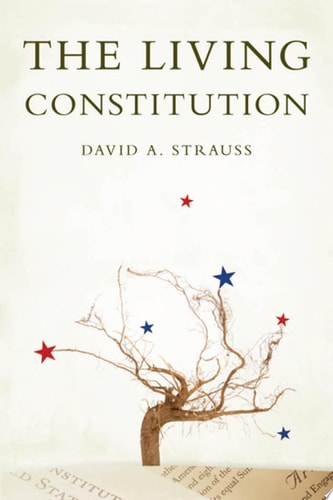
The Living Constitution
0
0
As an Amazon Associate and affiliate partner, Menrva Books earns from qualifying purchases. Learn more
Author Description
Supreme Court Justice Antonin Scalia once remarked that the theory of an evolving, living Constitution effectively rendered the Constitution useless. He wanted a dead Constitution, he joked, arguing it must be interpreted as the Framers originally understood it. In The Living Constitution, leading constitutional scholar David Strauss forcefully argues against the claims of Scalia, Clarence Thomas, Robert Bork, and other originalists, explaining in clear, jargon-free English how the Constitution can sensibly evolve, without falling into the anything-goes flexibility caricatured by opponents. The Living Constitution is not an out-of-touch liberal theory, Strauss further shows, but a mainstream tradition of American jurisprudence--a common-law approach to the Constitution, rooted in the written document but also based on precedent. Each generation has contributed precedents that guide and confine judicial rulings, yet allow us to meet the demands of today, not force us to follow the commands of the long-dead Founders. Strauss explores how judicial decisions adapted the Constitution's text (and contradicted original intent) to produce some of our most profound accomplishments: the end of racial segregation, the expansion of women's rights, and the freedom of speech. By contrast, originalism suffers from fatal flaws: the impossibility of truly divining original intent, the difficulty of adapting eighteenth-century understandings to the modern world, and the pointlessness of chaining ourselves to decisions made centuries ago. David Strauss is one of our leading authorities on constitutional law--one with practical knowledge as well, having served as Assistant Solicitor General of the United States and argued eighteen cases before the United States Supreme Court. Now he offers a profound new understanding of how the Constitution can remain vital to life in the twenty-first century.
Menrva's Summary
THE THESIS
The core question investigated is whether the United States Constitution should be interpreted through the rigid lens of original intent or through a flexible, common-law tradition that allows for evolution. David A. Strauss, a distinguished constitutional scholar and former Assistant Solicitor General, argues that the Constitution is not a static document but a living framework. He posits that American jurisprudence has historically relied on a common-law approach, where precedent and judicial adaptation ensure the document remains relevant to contemporary societal needs without abandoning its foundational text.
THE SCOPE MAP
What You Will Find
- A critique of originalist legal theories championed by figures such as Antonin Scalia and Clarence Thomas.
- An analysis of the common-law approach to constitutional interpretation and its historical roots in American law.
- Case studies examining the evolution of rights, including the end of racial segregation and the expansion of women's rights.
- A discussion on the practical limitations of divining original intent and the challenges of applying eighteenth-century mandates to modern governance.
THE AUTHORITY PERSPECTIVE
Legal scholars and practitioners frequently cite this work as a foundational text for understanding the debate between originalism and living constitutionalism. Readers note that Strauss successfully translates complex legal theory into accessible prose, making it a standard reference for those interested in the mechanics of American jurisprudence.
Page Count:
171
Publication Date:
2010-01-01
Publisher:
Oxford University Press
ISBN-10:
0199703698
ISBN-13:
9780199703692
Non-Fiction
History
Politics
Government
Law
Community Tags
Other Editions(2)
Similar Books


Reader Comments
Share Your Thoughts
No comments yet. Be the first to share your thoughts!