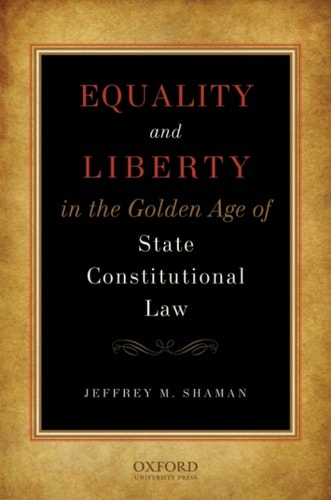
Equal Liberty: The Gold Age of State Constitutional Law
0
0
As an Amazon Associate and affiliate partner, Menrva Books earns from qualifying purchases. Learn more
Author Description
The rise of the New Judicial Federalism movement in the 1970s marked a sea-change in the history of state constitutional law by shifting the focus of power away from the central government in ways that had not occurred since the Equal Protection Clause was enacted in 1868. With New Judicial Federalism, many states rediscovered that they were empowered to enact their own constitutions and to interpret them as they saw fit, which enabled states to recognize civil rights and liberties beyond those recognized under the Federal Constitution.Equality and Liberty in the Golden Age of State Constitutional Law closely examines the evolution of the rights of liberty and equality under state constitutions from both a historical and jurisprudential perspective. In it, Professor Jeffrey M. Shaman explains that as New Judicial Federalism gained ground, state constitutional law became an important source for the protection of individual rights and liberties. States have since expanded the right of the citizen well beyond the limits of federal law by striking down laws that led to de facto segregation in public schools, discriminated against women, or allocated public benefits inequitably. State courts were the first to recognize a right of intimate association, spurring the U.S. Supreme Court to follow suit. Equality and Liberty in the Golden Age of State Constitutional Law is essential reading for anyone interested in this manifestation of law that has developed beyond the purview of national attention and in the resulting evolution of power in U.S. constitutional law.
Menrva's Summary
THE THESIS
This book investigates the historical and jurisprudential evolution of state constitutional law, specifically focusing on how the rise of New Judicial Federalism empowered states to expand civil rights and liberties beyond federal mandates. Professor Jeffrey M. Shaman, a legal scholar, utilizes historical analysis and case law review to argue that state constitutions serve as a critical, independent source of individual rights. By examining the shift in power dynamics since the 1970s, the author demonstrates how state courts have effectively bypassed federal limitations to address issues such as school segregation, gender discrimination, and public benefit allocation.
THE SCOPE MAP
What You Will Find
- Historical analysis of the New Judicial Federalism movement starting in the 1970s.
- Jurisprudential examination of state-level protections for equality and liberty.
- Case studies on state court rulings regarding public school segregation and gender discrimination.
- Discussion of the interplay between state constitutional interpretation and U.S. Supreme Court precedents.
THE AUTHORITY PERSPECTIVE
Legal scholars and practitioners identify this work as a significant contribution to the study of American federalism and the role of state judiciaries. Readers frequently note the academic rigor of the text, which provides a clear framework for understanding the divergence between state and federal constitutional protections.
Page Count:
296
Publication Date:
2008-01-01
Publisher:
Oxford University Press
ISBN-10:
019971522X
ISBN-13:
9780199715220
History
Constitutional Law
Professional Career & Trade
Government
Law
Constitutions
Civil Rights
Community Tags
Similar Books