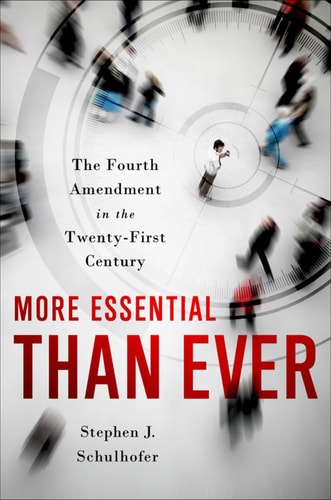
More Essential than Ever: The Fourth Amendment in the Twenty First Century
0
0
As an Amazon Associate and affiliate partner, Menrva Books earns from qualifying purchases. Learn more
Author Description
When the states ratified the Bill of Rights in the eighteenth century, the Fourth Amendment seemed straightforward. It requires that government respect the right of citizens to be "secure in their persons, houses, papers, and effects, against unreasonable searches and seizures." Of course, "papers and effects" are now digital and thus more vulnerable to government spying. But the biggest threat may be our own weakening resolve to preserve our privacy. In this potent new volume in Oxford's Inalienable Rights series, legal expert Stephen J. Schulhofer argues that the Fourth Amendment remains, as the title says, more essential than ever. From data-mining to airport body scans, drug testing and aggressive police patrolling on the streets, privacy is under assault as never before--and we're simply getting used to it. But the trend is threatening the pillars of democracy itself, Schulhofer maintains. "Government surveillance may not worry the average citizen who reads best-selling books, practices a widely accepted religion, and adheres to middle-of-the-road political views," he writes. But surveillance weighs on minorities, dissenters, and unorthodox thinkers, "chilling their freedom to read what they choose, to say what they think, and to associate with others who are like-minded." All of us are affected, he adds. "When unrestricted search and surveillance powers chill speech and religion, inhibit gossip and dampen creativity, they undermine politics and impoverish social life for everyone." Schulhofer offers a rich account of the history and nuances of Fourth Amendment protections, as he examines such issues as street stops, racial profiling, electronic surveillance, data aggregation, and the demands of national security. The Fourth Amendment, he reminds us, explicitly authorizes invasions of privacy--but it requires justification and accountability, requirements that reconcile public safety with liberty.
Menrva's Summary
THE THESIS
This book investigates whether the Fourth Amendment remains a viable protection for individual privacy in an era of pervasive digital surveillance and shifting social norms. Legal scholar Stephen J. Schulhofer examines the historical intent of the amendment alongside modern technological advancements that have rendered traditional privacy protections vulnerable. He argues that the erosion of privacy rights through data mining, aggressive policing, and national security measures threatens the foundational pillars of democratic society. By analyzing the tension between public safety and individual liberty, the author provides a framework for understanding why constitutional accountability is more critical now than at any point in American history.
THE SCOPE MAP
What You Will Find
- Historical analysis of the Fourth Amendment and its original application to physical property.
- Examination of modern privacy threats including data mining, electronic surveillance, and racial profiling.
- Case studies detailing the impact of surveillance on dissenters, minorities, and unorthodox thinkers.
- A legal framework for reconciling government security requirements with the constitutional mandate for accountability.
THE AUTHORITY PERSPECTIVE
Legal experts and scholars frequently cite this work as a vital contribution to the discourse on constitutional rights in the digital age. Readers often note the clarity with which Schulhofer connects complex legal precedents to the everyday realities of modern surveillance.
Page Count:
214
Publication Date:
2012-01-01
Publisher:
Oxford University Press
ISBN-10:
0199752990
ISBN-13:
9780199752997
History
Politics
United States
Privacy
Law
Constitutions
Civil Rights
Constitutional Law
Professional Career & Trade
Community Tags
Other Editions(2)
Similar Books




Reader Comments
Share Your Thoughts
No comments yet. Be the first to share your thoughts!