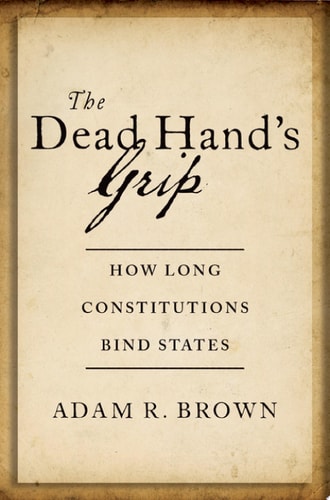
The Dead Hand's Grip: How Long Constitutions Bind States
0
0
As an Amazon Associate and affiliate partner, Menrva Books earns from qualifying purchases. Learn more
Author Description
In This Book, The Author Examines Constitutional Specificity - Or Length - As A Way To Evaluate How Different Polities Govern Citizens And Regulate Themselves. As The Author Shows, Many States And Nations Bloat Their Constitutions With Procedural And Policy Details That Other Polities Leave To Statutory Or Regulatory Discretion. American State Constitutions Vary In Length From Under 9,000 To Almost 400,000 Words. Constitutional Endurance Has Often Provoked Fears That The Dead Hand Of The Past May Reach Into The Present; Lengthy Constitutions Strengthen The Dead Hand's Grip, Binding States To A Former Generation's Solutions To Modern Problems. The Author Argues That Excessive Constitutional Specificity Restricts State Discretion, With Three Major Results. First, It Compels States To Rely More Frequently On Burdensome Amendment Procedures, Increasing Constitutional Amendment Rates. Second, It Increases Judicial Invalidation Rates As State Supreme Courts Enforce Narrower Limits On State Action. Third And Most Importantly, It Results In Severely Reduced Economic Performance, With Lower Incomes, Higher Unemployment, Greater Inequality, And Reduced Policy Innovativeness Generally. In Short, Long Constitutions Hurt States. -- Introducing Constitutional Specificity -- Contextualizing Specificity -- Specificity And Amendments -- Specificity And Judicial Review -- Specificity And Prosperity -- Evaluating State Constitutions. Adam R. Brown. Includes Bibliographical References (pages [165]-179) And Index.
Menrva's Summary
THE THESIS
This book investigates the relationship between constitutional specificity and the governance efficiency of states, specifically questioning how the length of a constitution impacts a state's ability to adapt to modern challenges. Adam R. Brown utilizes a comparative analysis of American state constitutions to demonstrate how excessive procedural detail restricts legislative discretion. By examining the correlation between document length and political outcomes, the author argues that overly specific constitutions create rigid frameworks that hinder economic performance and increase judicial intervention.
THE SCOPE MAP
What You Will Find
- Comparative analysis of American state constitutions ranging from 9,000 to 400,000 words.
- Quantitative assessment of constitutional amendment rates in relation to document length.
- Examination of judicial invalidation rates and state supreme court enforcement patterns.
- Empirical evidence linking constitutional specificity to economic indicators such as income, unemployment, and policy innovation.
THE AUTHORITY PERSPECTIVE
Scholars in the field of political science and constitutional law recognize this work as a significant contribution to the study of institutional design and state-level governance. Readers frequently note the clarity of the author's empirical approach in connecting historical constitutional drafting to contemporary economic outcomes.
Page Count:
336
Publication Date:
2022-01-01
Publisher:
Oxford University Press
ISBN-10:
0197655300
ISBN-13:
9780197655306
Economics
United States
Constitutions
Comparative Politics
Government
Constitutional Law
American Government
Law
Community Tags
Similar Books