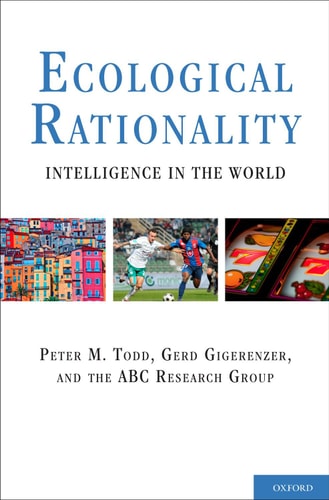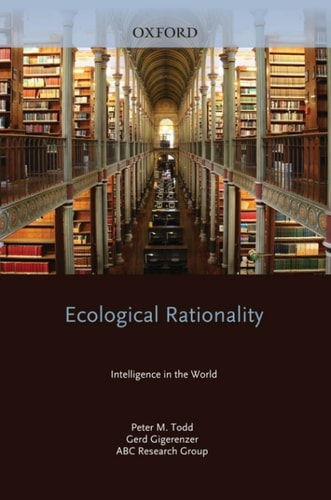
Ecological Rationality: Intelligence in the World
0
0
As an Amazon Associate and affiliate partner, Menrva Books earns from qualifying purchases. Learn more
Author Description
"More information is always better, and full information is best. More computation is always better, and optimization is best." More-is-better ideals such as these have long shaped our vision of rationality. Yet humans and other animals typically rely on simple heuristics to solve adaptive problems, focusing on one or a few important cues and ignoring the rest, and shortcutting computation rather than striving for as much as possible. In this book, we argue that in an uncertain world, more information and computation are not always better, and we ask when, and why, less can be more. The answers to these questions constitute the idea of ecological rationality: how we are able to achieve intelligence in the world by using simple heuristics matched to the environments we face, exploiting the structures inherent in our physical, biological, social, and cultural surroundings.
Menrva's Summary
THE THESIS
This book investigates the core question of how organisms achieve intelligence in uncertain environments by utilizing simple heuristics rather than complex optimization. Authors Gerd Gigerenzer and Peter M. Todd, both prominent researchers in the fields of psychology and cognitive science, challenge the traditional 'more-is-better' model of rationality. They argue that human and animal cognition is adapted to exploit the structures of the environment, demonstrating that limited information and computation can often lead to more effective decision-making than exhaustive analysis.
THE SCOPE MAP
What You Will Find
- Theoretical framework of ecological rationality and bounded rationality
- Analysis of simple heuristics versus complex optimization models
- Case studies examining decision-making in physical, biological, and social environments
- Exploration of how environmental structures dictate cognitive success
THE AUTHORITY PERSPECTIVE
Experts recognize this work as a foundational text in the study of adaptive cognition and behavioral decision theory. Readers frequently note the academic density of the prose, which provides a rigorous examination of how heuristics function in real-world contexts.
Page Count:
608
Publication Date:
2012-01-01
Publisher:
Oxford University Press
ISBN-10:
019971794X
ISBN-13:
9780199717941
Psychology
Evolutionary Biology
Decision Making