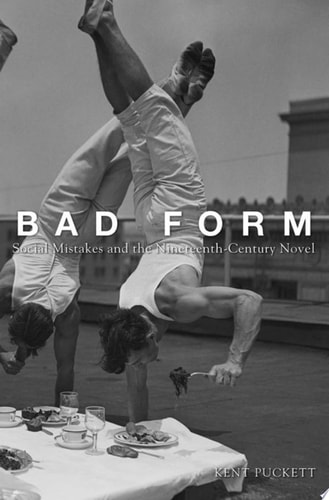
Bad Form: Social Mistakes and the Nineteenth-Century Novel
0
0
As an Amazon Associate and affiliate partner, Menrva Books earns from qualifying purchases. Learn more
Author Description
What--other than embarrassment--could one hope to gain from prolonged exposure to the social mistake? Why think much about what many would like simply to forget? Bad Form argues that whatever its awkwardness, the social mistake--the blunder, the gaffe, the faux pas-is a figure of critical importance to the nineteenth-century novel. With significant new readings of a number of nineteenth-century works--such as Eliot's Middlemarch, Flaubert's Madame Bovary, and James's The Princess Casamassima--Kent Puckett reveals how the novel achieves its coherence thanks to minor mistakes that novels both represent and make. While uncovering the nineteenth-century novel's persistent social and structural reliance on the non-catastrophic mistake--eating peas with your knife, saying the wrong thing, overdressing--this lively study demonstrates that the novel's once considerable cultural authority depends on what we might otherwise think of as that authority's opposite: a jittery, anxious, obsessive attention to the mistakes of others that is its own kind of bad form. Looking at last beyond the novel, Puckett concludes with a reading of Jean Renoir's classic film, The Rules of the Game, in order to consider the related fates of bourgeois sociability, the classic realist novel, and the social mistake. Drawing on sociology, psychoanalysis, narrative theory, and the period's large literature on etiquette, Puckett demonstrates that the nineteenth-century novel paradoxically relies on bad form in order to secure its own narrative form. Bad Form makes the case for the critical role that making mistakes plays in the nineteenth-century novel.
Menrva's Summary
THE THESIS
How does the social mistake, often dismissed as a mere gaffe, function as a structural necessity for the coherence and authority of the nineteenth-century novel? Kent Puckett, a scholar of literary theory, examines the intersection of etiquette, sociology, and narrative form to argue that the nineteenth-century novel relies on the non-catastrophic mistake to maintain its cultural standing. By analyzing the tension between social anxiety and narrative structure, Puckett demonstrates that the very blunders characters commit are essential to the development of the realist novel.
THE SCOPE MAP
What You Will Find
- Analysis of canonical nineteenth-century texts including Middlemarch, Madame Bovary, and The Princess Casamassima
- Integration of sociological, psychoanalytic, and narrative theory frameworks
- Examination of historical etiquette literature and its influence on character behavior
- A concluding study on Jean Renoir’s film The Rules of the Game to contextualize the decline of bourgeois sociability
THE AUTHORITY PERSPECTIVE
Scholars and critics recognize this work as a sophisticated contribution to narrative theory that challenges traditional views on realist fiction. Readers frequently note the academic density of the prose, which effectively bridges the gap between social history and literary mechanics.
Page Count:
192
Publication Date:
2008-01-01
Publisher:
Oxford University Press
ISBN-10:
019971570X
ISBN-13:
9780199715701
History
Narrative Theory
British & Irish
Film Studies
Sociology
Kindle Store
Kindle eBooks
Fiction
Categories
Criticism history
Nineteenth century
Literary Criticism
Community Tags
Similar Books