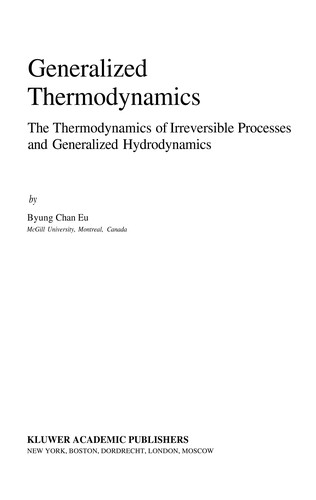
Generalized Thermodynamics
0
0
As an Amazon Associate and affiliate partner, Menrva Books earns from qualifying purchases. Learn more
Author Description
This monograph presents, from the viewpoint of continuum mechanics, a newly emerging field of irreversible thermodynamics, in which linear irreversible thermodynamics are extended to the nonlinear regime and macroscopic phenomena far removed from equilibrium are studied in a manner consistent with the laws of thermodynamics. The tool to develop this thermodynamic theory of irreversible processes are the generalized thermodynamics, which also extends the classical hydrodynamics of Navier, Stokes and Fourier to nonlinear irreversible processes. On the basis of mathematically rigorous representations of the first and the second law of thermodynamics, phenomenological theory (continuum mechanics) deductions are made from the thermodynamic laws of R. Clausius and Lord Kelvin and by this continuum mechanics theories are formulated for macroscopic irreversible processes occurring far removed from equilibrium. Non-equilibrium thermodynamics are developed for thermodynamic functions.
Menrva's Summary
THE THESIS
This monograph investigates the extension of linear irreversible thermodynamics into the nonlinear regime and the study of macroscopic phenomena far from equilibrium. The work, presented from the viewpoint of continuum mechanics, utilizes generalized thermodynamics to bridge classical hydrodynamics with nonlinear irreversible processes. By establishing mathematically rigorous representations of the first and second laws of thermodynamics, the book formulates continuum mechanics theories for macroscopic irreversible processes occurring far from equilibrium, developing non-equilibrium thermodynamics for thermodynamic functions.
THE SCOPE MAP
- A newly emerging field of irreversible thermodynamics, extending linear thermodynamics to the nonlinear regime.
- Study of macroscopic phenomena far removed from equilibrium, consistent with thermodynamic laws.
- Application of generalized thermodynamics as a tool for developing thermodynamic theory of irreversible processes.
- Extension of classical hydrodynamics of Navier, Stokes, and Fourier to nonlinear irreversible processes.
- Formulation of continuum mechanics theories for macroscopic irreversible processes based on rigorous representations of thermodynamic laws.
- Development of non-equilibrium thermodynamics for thermodynamic functions.
THE AUTHORITY PERSPECTIVE
The book is presented as a monograph detailing a specific, emerging field within thermodynamics. Its focus on extending classical theories into nonlinear and non-equilibrium states suggests a text aimed at specialists in continuum mechanics and advanced thermodynamics. The rigorous mathematical approach indicated by the description implies a dense, technical read for researchers and advanced graduate students in the field.
Page Count:
342
Publication Date:
2002-01-01
ISBN-10:
1402007884
Non-Fiction
Science
Continuum mechanics
Physics
Thermodynamics
Community Tags
Similar Books