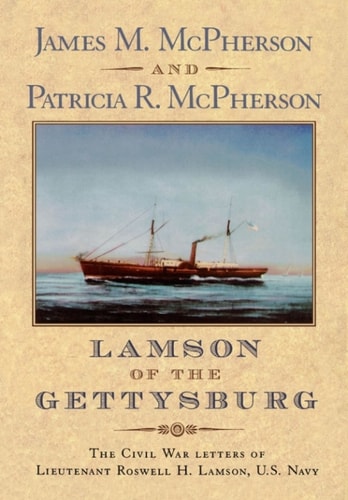
Lamson of the Gettysburg: The Civil War Letters of Lieutenant Roswell H. Lamson, U.S. Navy
0
0
As an Amazon Associate and affiliate partner, Menrva Books earns from qualifying purchases. Learn more
Author Description
Roswell Lamson was one of the boldest and most skillful young officers in the Union navy. Second in the class of 1862 at Annapolis (he took his final exam while at sea during the war), he commanded more ships and flotillas than any other officer of his age or rank in the service, climaxed by his captaincy of the navy's fastest ship in 1864, USS Gettysburg. Now, in Lamson of the Gettysburg, we have the war-time letters of this striking naval figure. What's more, these are letters of exceptional quality. James M. McPherson, co-editor of the collection with his wife Patricia and one of America's preeminent Civil War historians, writes that "few sets of letters equal and none surpass those of Lamson for richness of description, scope of coverage, or keenness of perception and analysis." Indeed, the McPhersons term Lamson's correspondence "the best Civil War navy letters we have ever read or expect to read."Throughout the war, Lamson always seemed to be where the action was on the South Atlantic coast, and these letters describe with striking immediacy the part he played in these events. While serving on the USS Wabash, for instance, he directed the big deck guns that did the most damage to enemy forts at Hatteras Inlet and Port Royal, two major naval victories. He was the officer who took command of the CSS Planter in May 1862, when slaves led by Robert Smalls ran her past Confederate fortifications in Charleston harbor and delivered her to the Union fleet. He commanded a gunboat fleet on the Nansemond River that helped stop James Longstreet's advance on Norfolk. In a daring attempt to blow up Fort Fisher, the huge earthwork fortress that guarded the entrance into the Cape Fear river, he towed the USS Louisiana (packed with more than two hundred tons of gunpowder) directly under the guns of the fort, sneaking into the shallows behind a rebel blockade runner, (Lamson describes "a terrific explosion. An immense column of flame rose towards the sky, and four distinct repor
Menrva's Summary
THE THESIS
This collection investigates the naval operations and strategic realities of the American Civil War through the primary source correspondence of Lieutenant Roswell H. Lamson. James M. McPherson, a preeminent Civil War historian, and Patricia R. McPherson provide the editorial framework for these documents. The editors argue that Lamson’s letters offer an unparalleled perspective on the Union Navy, characterized by high-level tactical analysis and vivid, immediate reporting from the front lines of the South Atlantic coast.
THE SCOPE MAP
What You Will Find
- Detailed accounts of major naval engagements including Hatteras Inlet and Port Royal.
- First-hand observations regarding the capture of the CSS Planter and the actions of Robert Smalls.
- Strategic insights into the blockade of the Nansemond River and the defense of Norfolk.
- Primary source documentation of the daring attempt to neutralize Fort Fisher using the USS Louisiana.
THE AUTHORITY PERSPECTIVE
Historians and scholars regard this collection as a foundational text for understanding the Union Navy's operational capabilities during the Civil War. The prose is noted for its exceptional clarity and analytical depth, making it a primary resource for both academic researchers and enthusiasts of 19th-century military history.
Page Count:
272
Publication Date:
1999-01-01
Publisher:
Oxford University Press
ISBN-10:
0199727929
ISBN-13:
9780199727926
History
Biography
Military History
Naval history
Civil War
American History
English & College Success
Letters
Biography Autobiography
English
Community Tags
Similar Books








Reader Comments
Share Your Thoughts
No comments yet. Be the first to share your thoughts!