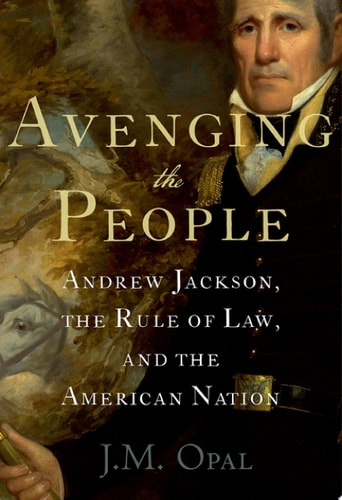
Avenging the People: Andrew Jackson, the Rule of Law, and the American Nation
0
0
As an Amazon Associate and affiliate partner, Menrva Books earns from qualifying purchases. Learn more
Author Description
Most Americans know Andrew Jackson as a frontier rebel against political and diplomatic norms, a "populist" champion of ordinary people against the elitist legacy of the Founding Fathers. Many date the onset of American democracy to his 1829 inauguration. Despite his reverence for the "sovereign people," however, Jackson spent much of his career limiting that sovereignty, imposing new and often unpopular legal regimes over American lands and markets. He made his name as a lawyer, businessman, and official along the Carolina and Tennessee frontiers, at times ejecting white squatters from native lands and returning slaves to native planters in the name of federal authority and international law. On the other hand, he waged total war on the Cherokees and Creeks who terrorized western settlements and raged at the national statesmen who refused to "avenge the blood" of innocent colonists. During the long war in the south and west from 1811 to 1818 he brushed aside legal restraints on holy genocide and mass retaliation, presenting himself as the only man who would protect white families from hostile empires, "heathen" warriors, and rebellious slaves. He became a towering hero to those who saw the United States as uniquely lawful and victimized. And he used that legend to beat back a range of political, economic, and moral alternatives for the republican future.Drawing from new evidence about Jackson and the southern frontiers, Avenging the People boldly reinterprets the grim and principled man whose version of American nationhood continues to shape American democracy.
Menrva's Summary
THE THESIS
This book investigates the contradiction between Andrew Jackson’s public image as a champion of popular sovereignty and his actual record of imposing rigid, often exclusionary legal regimes. J.M. Opal, a historian specializing in early American history, utilizes archival evidence from the southern frontiers to challenge the traditional narrative of Jackson as a simple populist rebel. The author argues that Jackson’s version of American nationhood was defined by a selective application of law, which he used to consolidate federal power while simultaneously justifying total war against indigenous populations and enforcing strict social hierarchies.
THE SCOPE MAP
What You Will Find
- Analysis of Jackson’s early career as a lawyer and businessman on the Carolina and Tennessee frontiers.
- Examination of the legal and military actions taken during the southern and western conflicts from 1811 to 1818.
- Investigation into the rhetoric of "avenging the blood" of white settlers as a political tool.
- Exploration of how Jackson’s actions shaped the development of American democracy and national identity.
Scope Limits
- The book does not provide a comprehensive cradle-to-grave biography of Jackson’s entire life.
- It focuses primarily on the southern and western frontier experiences rather than his full tenure as President.
THE AUTHORITY PERSPECTIVE
Scholars and historians recognize this work as a significant re-evaluation of Jacksonian political ideology, noting its focus on the intersection of frontier violence and legal authority. Readers frequently highlight the author's ability to synthesize complex legal history with the brutal realities of early American expansionism.
Page Count:
351
Publication Date:
2017-01-01
Publisher:
Oxford University Press
ISBN-10:
0190660260
ISBN-13:
9780190660260
Biography
History
Military History
United States
Law
19th Century
Biography Autobiography
English
English & College Success
History of the Americas
Rule Of Law
American History
Community Tags
Similar Books