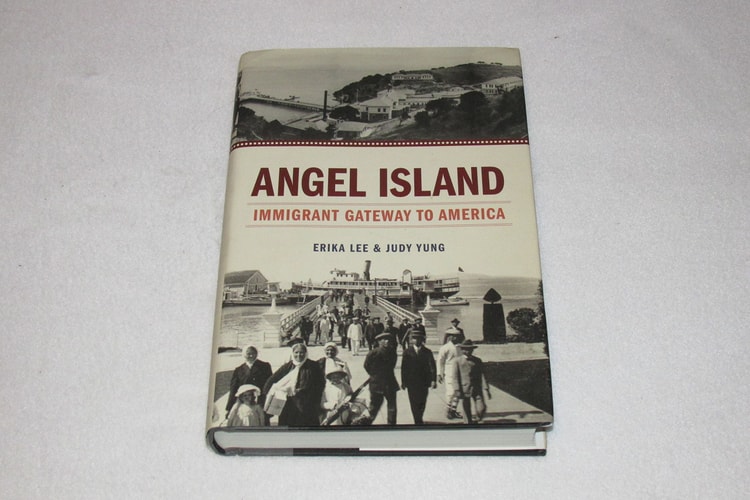
Angel Island: Immigrant Gateway to America
0
0
As an Amazon Associate and affiliate partner, Menrva Books earns from qualifying purchases. Learn more
Author Description
From 1910 to 1940, the Angel Island immigration station in San Francisco served as the processing and detention center for over one million people from around the world. The majority of newcomers came from China and Japan, but there were also immigrants from India, the Philippines, Korea, Russia, Mexico, and over seventy other countries. The full history of these immigrants and their experiences on Angel Island is told for the first time in this landmark book, published to commemorate the immigration station's 100th anniversary.Based on extensive new research and oral histories, Angel Island: Immigrant Gateway to America examines the great diversity of immigration through Angel Island: Chinese "paper sons," Japanese picture brides, Korean refugee students, South Asian political activists, Russian and Jewish refugees, Mexican families, Filipino workers, and many others. Together, their stories offer a more complete and complicated history of immigration to America than we have ever known.Like its counterpart on Ellis Island, the immigration station on Angel Island was one of the country's main ports of entry for immigrants in the early twentieth century. But while Ellis Island was mainly a processing center for European immigrants, Angel Island was designed to detain and exclude immigrants from Asia. The immigrant experience on Angel Island-more than any other site-reveals how U.S. immigration policies and their hierarchical treatment of immigrants according to race, ethnicity, class, nationality, and gender played out in daily practices and decisions at the nation's borders with real consequences on immigrant lives and on the country itself.Angel Island: Immigrant Gateway to America is officially sponsored by the Angel Island Immigration Station.
Menrva's Summary
THE THESIS
This book investigates the complex history of the Angel Island immigration station, examining how U.S. border policies functioned as tools of exclusion and racial hierarchy between 1910 and 1940. Erika Lee and Judy Yung, both established scholars in Asian American history, utilize a combination of archival research and personal oral histories to reconstruct the experiences of the over one million people who passed through the facility. The authors argue that Angel Island serves as a critical site for understanding the intersection of race, class, and nationality in the formation of American immigration policy. By contrasting the station with Ellis Island, the text provides a framework for analyzing how the U.S. government managed diverse populations through detention and systematic exclusion.
THE SCOPE MAP
What You Will Find
- A comprehensive historical analysis of the Angel Island immigration station from 1910 to 1940.
- Detailed case studies of diverse immigrant groups, including Chinese paper sons, Japanese picture brides, and South Asian political activists.
- Primary source evidence derived from government records, personal diaries, and oral history interviews.
- An examination of the systemic impact of U.S. immigration policies on gender, class, and ethnic hierarchies at the nation's borders.
THE AUTHORITY PERSPECTIVE
Experts and historians recognize this work as a foundational text for understanding the Pacific coast immigration experience. Readers frequently note the meticulous research and the authors' ability to synthesize vast amounts of archival data into a coherent, accessible narrative.
Page Count:
432
Publication Date:
2010-08-27
Publisher:
Oxford University Press
ISBN-10:
0199734089
ISBN-13:
9780199734085
History
American History
United States
Immigration
California history
San Francisco
Social Science
Community Tags
Other Editions(2)

Similar Books












Reader Comments
Share Your Thoughts
No comments yet. Be the first to share your thoughts!