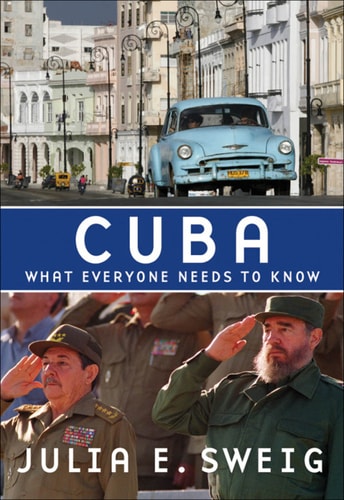
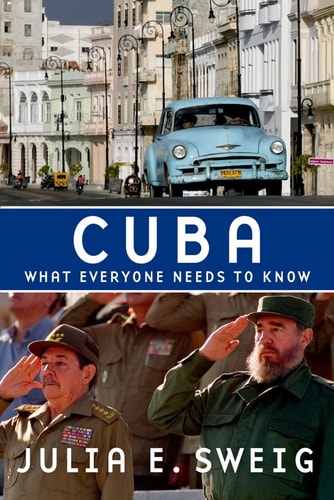
Cuba: What Everyone Needs to Know
0
0
As an Amazon Associate and affiliate partner, Menrva Books earns from qualifying purchases. Learn more
Author Description
Ever since Fidel Castro assumed power in Cuba in 1959, Americans have obsessed about the nation ninety miles south of the Florida Keys. America's fixation on the tropical socialist republic has only grown over the years, fueled in part by successive waves of Cuban immigration and Castro's larger-than-life persona. Cubans are now a major ethnic group in Florida, and the exile community is so powerful that every American president has kowtowed to it. But what do most Americans really know about Cuba itself? In Cuba: What Everyone Needs to Know, Julia Sweig, one of America's leading experts on Cuba and Latin America, presents a concise and remarkably accessible portrait of the small island nation's unique place on the world stage over the past fifty years. Yet it is authoritative as well. Following a scene-setting introduction that describes the dynamics unleashed since summer 2006 when Fidel Castro transferred provisional power to his brother Raul, the book looks backward toward Cuba's history since the Spanish American War before shifting to more recent times. Focusing equally on Cuba's role in world affairs and its own social and political transformations, Sweig divides the book chronologically into the pre-Fidel era, the period between the 1959 revolution and the fall of the Soviet Union, the post-Cold War era, and-finally-the looming post-Fidel era. Informative, pithy, and lucidly written, it will serve as the best compact reference on Cuba's internal politics, its often fraught relationship with the United States, and its shifting relationship with the global community.
Menrva's Summary
THE THESIS
What are the fundamental historical, political, and social dynamics that define Cuba's internal development and its complex relationship with the United States? Julia E. Sweig, a senior fellow and expert on Latin American affairs, utilizes her extensive research to provide a clear, objective framework for understanding the island's trajectory. By examining the nation's evolution from the Spanish-American War through the transition of power from Fidel to Raul Castro, the author offers a comprehensive analysis of the forces shaping the Cuban state. The text serves as a structured guide to the island's internal governance and its shifting position within the global community.
THE SCOPE MAP
What You Will Find
- Historical analysis of Cuba from the Spanish-American War to the post-Fidel era.
- Examination of the political and social transformations following the 1959 revolution.
- Assessment of the impact of the Cuban exile community on United States foreign policy.
- Evaluation of Cuba's shifting diplomatic and economic relationships in the post-Cold War world.
THE AUTHORITY PERSPECTIVE
Experts and academics frequently cite this work as a foundational, balanced reference for those seeking to understand the complexities of Cuban politics. Readers often note the clarity of the prose, which manages to distill dense historical and geopolitical information into an accessible format.
Page Count:
308
Publication Date:
2009-01-01
Publisher:
Oxford University Press
ISBN-10:
019974081X
ISBN-13:
9780199740819
Politics
History
Comparative Politics
Social Science
American History
Latin America
International relations
West Indies
Community Tags
Other Editions(5)
Similar Books




Reader Comments
Share Your Thoughts
No comments yet. Be the first to share your thoughts!