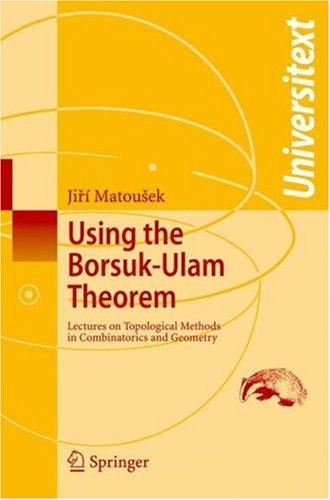
Using the Borsuk-Ulam Theorem
0
0
As an Amazon Associate and affiliate partner, Menrva Books earns from qualifying purchases. Learn more
Author Description
The "Kneser conjecture" -- posed by Martin Kneser in 1955 in the Jahresbericht der DMV -- is an innocent-looking problem about partitioning the k-subsets of an n-set into intersecting subfamilies. Its striking solution by L. Lovász featured an unexpected use of the Borsuk-Ulam theorem, that is, of a genuinely topological result about continuous antipodal maps of spheres. Matousek's lively little textbook now shows that Lovász' insight as well as beautiful work of many others (such as Vrecica and Zivaljevic, and Sarkaria) have opened up an exciting area of mathematics that connects combinatorics, graph theory, algebraic topology and discrete geometry. What seemed like an ingenious trick in 1978 now presents itself as an instance of the "test set paradigm": to construct configuration spaces for combinatorial problems such that coloring, incidence or transversal problems may be translated into the (non-)existence of suitable equivariant maps. The vivid account of this area and its ramifications by Matousek is an exciting, a coherent account of this area of topological combinatorics. It features a collection of mathematical gems written with a broad view of the subject and still with loving care for details. Recommended reading! […]
Menrva's Summary
THE THESIS
This book explores the application of the Borsuk-Ulam theorem to solve combinatorial problems, particularly focusing on the Kneser conjecture. It details how the theorem, a topological result concerning continuous maps of spheres, was unexpectedly used to solve this conjecture, opening up a new area of mathematics that bridges combinatorics, graph theory, algebraic topology, and discrete geometry. The text presents the
THE SCOPE MAP
- The Kneser conjecture and its solution using the Borsuk-Ulam theorem.
- The application of topological results to combinatorial problems.
- The "test set paradigm" for constructing configuration spaces.
- Connections between combinatorics, graph theory, algebraic topology, and discrete geometry.
- Mathematical gems written with a broad view and attention to detail.
THE AUTHORITY PERSPECTIVE
The book is lauded for its vivid and coherent account of a burgeoning area of topological combinatorics, connecting diverse mathematical fields. It is recognized for presenting complex ideas with both a broad perspective and meticulous attention to detail, making it a valuable resource for those interested in the subject. The work is recommended for its collection of mathematical insights and its clear exposition of the "test set paradigm".
Page Count:
210
Publication Date:
2003-01-01
ISBN-10:
3540003622
Science
Non-Fiction
Mathematics
Combinatorics
Topology
Graph Theory
Community Tags
Similar Books