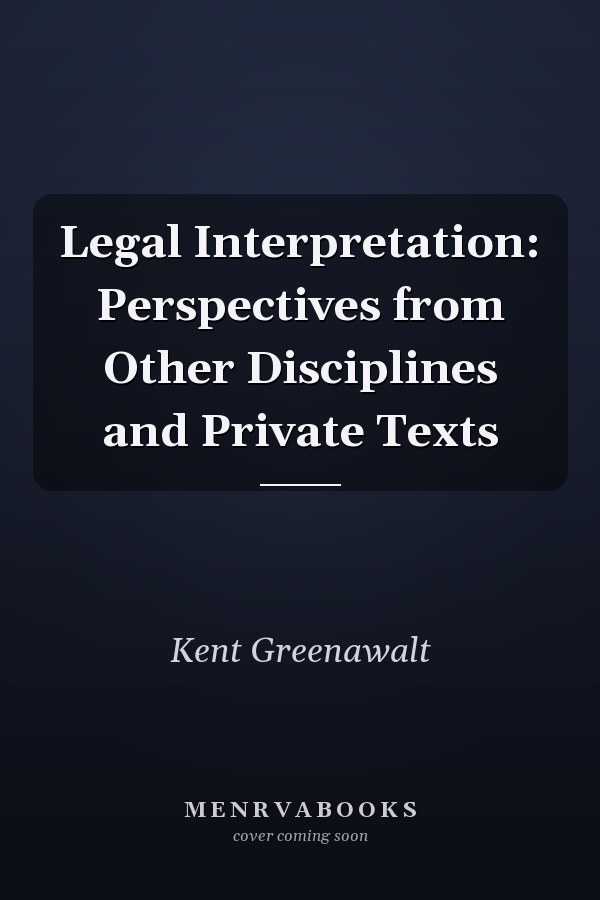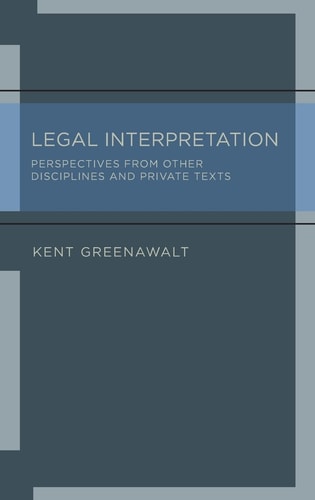
Legal Interpretation: Perspectives from Other Disciplines and Private Texts
0
0
As an Amazon Associate and affiliate partner, Menrva Books earns from qualifying purchases. Learn more
Author Description
In Legal Interpretation, Kent Greenawalt focuses on the complex and multi-faceted topic of textual interpretation of the law. All law needs to be interpreted, and there are many ways to do it. But what sorts of questions must one seek to answer in interpreting law and what approach should one take in each case? Whose interpretations should be prioritized? Why would one be drawn to one strategy over another? And should legal interpretation seek to satisfy specific aims or general objectives?In order to provide the answers to these questions, Greenawalt explores the ways in which interpretive strategies from other disciplines--the philosophy of language, literary and musical interpretation, religious interpretation, and general interpretive theory--can augment and enrich methods of legal interpretation. Over the course of the book, he suggests how such forms of interpretation are analogous to legal interpretation--and points to those cases in which interpretation must rest on the distinctive aspects of legal theory, such as is the case with private documents.Furthermore, Greenawalt's meditation suggests that interpretive strategies from other disciplines can shed light on the essential nature of legal interpretation and provide roads by which to account for dissonance between various methods of interpretation. Legal Interpretation is a thought-provoking reflection on the ways that insights from a range of intellectual traditions can deepen our understanding of law, particularly with regard to constitutional law.
Menrva's Summary
THE THESIS
This work investigates the fundamental question of how interpretive strategies from non-legal disciplines can inform and refine the methods used to interpret law. Kent Greenawalt, a prominent legal scholar, draws upon his extensive background in jurisprudence to analyze the complexities of textual interpretation. He argues that by examining analogies in philosophy, literature, music, and religion, legal practitioners can better navigate the dissonance between competing interpretive strategies. The book provides a framework for understanding when general interpretive theories apply to law and when the unique requirements of legal documents necessitate a specialized approach.
THE SCOPE MAP
What You Will Find
- Comparative analysis of interpretive methods across philosophy of language, literature, music, and religion.
- Examination of the specific challenges posed by the interpretation of private documents versus public law.
- Discussion of the role of constitutional law within broader interpretive frameworks.
- Theoretical exploration of how intellectual traditions can resolve conflicts between different legal strategies.
THE AUTHORITY PERSPECTIVE
Legal scholars and practitioners frequently cite this text as a sophisticated contribution to the study of jurisprudence and constitutional interpretation. Experts note the academic density of the prose, which serves as a rigorous resource for those interested in the intersection of legal theory and broader intellectual traditions.
Page Count:
368
Publication Date:
2010-11-24
Publisher:
Oxford University Press
ISBN-10:
0199756139
ISBN-13:
9780199756131
Philosophy
Legal Theory
Law
Constitutional Law
Interpretation and construction
Jurisprudence
Law Philosophy