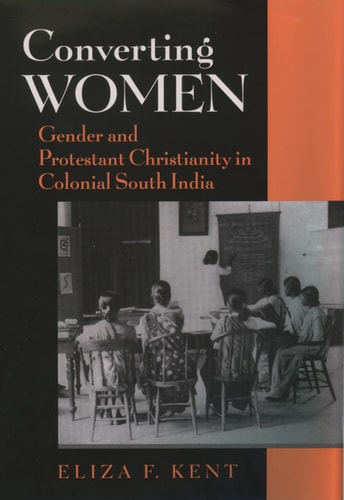
Converting Women: Gender and Protestant Christianity in Colonial South India
0
0
As an Amazon Associate and affiliate partner, Menrva Books earns from qualifying purchases. Learn more
Author Description
With the emergence of Hindu nationalism, the conversion of Indians to Christianity has become a volatile issue, erupting in violence against converts and missionaries. At the height of British colonialism, however, conversion was a path to upward mobility for low-castes and untouchables, especially in the Tamil-speaking south of India. In this book, Eliza F. Kent takes a fresh look at these conversions, focusing especially on the experience of women converts and the ways in which conversion transformed gender roles and expectations. Kent argues that the creation of a new, "respectable" community identity was central to the conversion process for the agricultural laborers and artisans who embraced Protestant Christianity under British rule. At the same time, she shows, this new identity was informed as much by elite Sanskritic customs and ideologies as by Western Christian discourse. Stigmatized by the dominant castes for their ritually polluting occupations and relaxed rules governing kinship and marriage, low-caste converts sought to validate their new higher-status identity in part by the reform of gender relations. These reforms affected ideals of femininity and masculinity in the areas of marriage, domesticity, and dress. By the creation of a "discourse of respectability," says Kent, Tamil Christians hoped to counter the cultural justifications for their social, economic, and sexual exploitation at the hands of high-caste landowners and village elites. Kent's focus on the interactions between Western women missionaries and the Indian Christian women not only adds depth to our understanding of colonial and patriarchal power dynamics, but to the intricacies of conversion itself. Posing an important challenge to normative notions of conversion as a privatized, individual moment in time, Kent's study takes into consideration the ways that public behavior, social status, and the transformation of everyday life inform religious conversion.
Menrva's Summary
THE THESIS
How did the adoption of Protestant Christianity by low-caste women in colonial South India function as a mechanism for social mobility and the construction of a new, respectable community identity? Eliza F. Kent, a scholar of religion and South Asian studies, utilizes historical archives and missionary records to examine the intersection of religious conversion, caste dynamics, and gender reform. She argues that conversion was not merely a spiritual transition but a strategic social project aimed at countering exploitation through the adoption of new domestic and behavioral norms.
THE SCOPE MAP
What You Will Find
- Analysis of the social and economic conditions of low-caste agricultural laborers and artisans in colonial Tamil-speaking India.
- Examination of the discourse of respectability and its influence on marriage, kinship, and dress codes.
- Investigation into the power dynamics between Western female missionaries and Indian Christian women.
Scope Limits
- The study focuses specifically on Protestant Christianity and does not provide an exhaustive analysis of all Christian denominations in the region.
- The research is geographically constrained to the Tamil-speaking areas of South India during the British colonial period.
THE AUTHORITY PERSPECTIVE
Scholars in the fields of post-colonial studies and religious history frequently cite this work for its nuanced approach to the agency of marginalized women in colonial settings. Experts highlight the text as a significant contribution to understanding how religious identity is constructed through the negotiation of social status and gendered expectations.
Page Count:
329
Publication Date:
2004-01-01
Publisher:
Oxford University Press
ISBN-10:
0190290048
ISBN-13:
9780190290047
History
Religion
Gender Studies
Asian History
Sociology
Woman Studies
Colonialism
Asian Studies
Community Tags
Similar Books