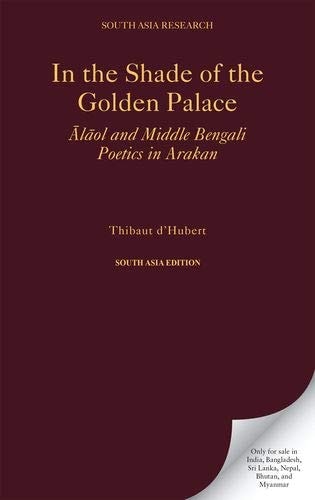
In the Shade of the Golden Palace
0
0
As an Amazon Associate and affiliate partner, Menrva Books earns from qualifying purchases. Learn more
Author Description
In the Shade of the Golden Palace explores the work of the prolific Bengali poet Alaol ( fl. 1651-71), who translated five narrative poems and one versified treatise from medieval Hindi and Persian into Bengali. The book maps the genres, structures, and themes of Alaol's works, paying special attention to his discourse on poetics and his literary genealogy, which included Sanskrit, Avadhi, Maithili, Persian, and Bengali authors. D'Hubert focuses on courtly speech in Alaol's poetry, his revisiting of classical categories in a vernacular context, and the prominent role of performing arts in his conceptualization of the poetics of the written word. The foregrounding of this audacious theory of meaning in Alaol's poetry is a crucial contribution of the book, both in terms of general conceptual analysis and for its significance in the history of Bengali poetry.This book shows how multilingual literacy fostered a variety of literary experiments in the remote kingdom of Arakan, which lay between present-day southeastern Bangladesh and Myanmar, in the mid-17th century. D'Hubert also presents a detailed analysis of Middle Bengali narrative poems, as well as translations of Old Maithili, Brajabuli, and Middle Bengali lyric poems that illustrate the major poetic styles in the regional courts of eastern South Asia. In the Shade of the Golden Palace therefore fulfills three it is a unique guide for readers of Middle Bengali poetry, a detailed study of the cultural history of the frontier region of Arakan, and an original contribution to the poetics of South Asian literatures.
Menrva's Summary
THE THESIS
This book investigates how the 17th-century Bengali poet Alaol synthesized diverse linguistic and cultural traditions to create a sophisticated vernacular poetics within the Arakan court. Thibaut D'Hubert, a scholar specializing in South Asian literatures, utilizes a rigorous analysis of Alaol's translations and original treatises to argue that multilingual literacy was the primary driver of literary innovation in the region. By examining the intersection of Sanskrit, Persian, and regional vernaculars, the author demonstrates how Alaol redefined classical poetic categories for a new audience.
THE SCOPE MAP
What You Will Find
- Analysis of Alaol's translations from Hindi and Persian into Middle Bengali
- Examination of courtly speech and the influence of performing arts on written poetry
- Historical context of the Arakan kingdom in the mid-17th century
- Translations of Old Maithili, Brajabuli, and Middle Bengali lyric poems
Scope Limits
- The study is restricted to the specific literary output of Alaol and the immediate cultural sphere of the Arakan court
- It does not provide a comprehensive history of all Bengali literature beyond the 17th-century frontier context
THE AUTHORITY PERSPECTIVE
Scholars recognize this work as a significant contribution to the study of South Asian literary history and the specific development of Middle Bengali poetry. Experts highlight the book's academic density and its success in bridging the gap between historical cultural studies and formal poetic analysis.
Page Count:
0
Publication Date:
1900-01-01
Publisher:
Oxford
ISBN-10:
0190084375
ISBN-13:
9780190084370
Poetry
Literary Criticism
Asian History