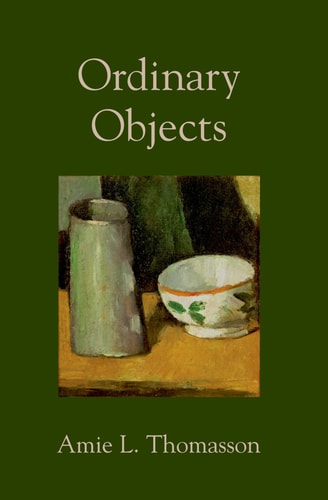
Ordinary Objects
0
0
As an Amazon Associate and affiliate partner, Menrva Books earns from qualifying purchases. Learn more
Author Description
Arguments that ordinary inanimate objects such as tables and chairs, sticks and stones, simply do not exist have become increasingly common and increasingly prominent. Some are based on demands for parsimony or for a non-arbitrary answer to the special composition question; others arise from prohibitions against causal redundancy, ontological vagueness, or co-location; and others still come from worries that a common sense ontology would be a rival to a scientific one.Until now, little has been done to address these arguments in a unified and systematic way. Ordinary Objects is designed to fill this gap, demonstrating that the mistakes behind all of these superficially diverse eliminativist arguments may be traced to a common source. It aims to develop an ontology of ordinary objects subject to no such problems, providing perhaps the first sustained defense of a common sense ontology in two generations. The work done along the way addresses a number of major issues in philosophy of language and metaphysics, contributing to debates about analyticity, identity conditions, co-location and the grounding problem, vagueness, overdetermination, parsimony, and ontological commitment.In the end, the most important result of addressing these eliminativist arguments is not merely avoiding their conclusions; examining their failings also gives us reason to suspect that many apparent disputes in ontology are pseudo-debates. For it brings into question widely-held assumptions about which uses of metaphysical principles are appropriate, which metaphysical demands are answerable, and how we should go about addressing such fundamental questions as "What exists?". As a result, the work of Ordinary Objects promises to provide not only the route to a reflective understanding of our unreflective common-sense view, but also a better understanding of the proper methods and limits of metaphysics.
Menrva's Summary
THE THESIS
Does the common-sense existence of ordinary inanimate objects hold up against modern eliminativist arguments in metaphysics? Amie Thomasson, a prominent philosopher, addresses the growing trend of arguments claiming that everyday items like tables and chairs do not exist. She systematically deconstructs the diverse motivations behind these claims—ranging from concerns about causal redundancy to ontological vagueness—and argues that they stem from a shared set of fundamental errors. By identifying these mistakes, the author provides a robust defense of a common-sense ontology while simultaneously questioning the validity of many contemporary metaphysical debates.
THE SCOPE MAP
What You Will Find
- A comprehensive analysis of eliminativist arguments regarding material objects.
- A systematic critique of metaphysical principles such as parsimony, co-location, and the grounding problem.
- A meta-philosophical investigation into the nature of ontological disputes and pseudo-debates.
- A proposed framework for understanding the limits and proper methods of metaphysical inquiry.
THE AUTHORITY PERSPECTIVE
Experts recognize this work as a significant contribution to contemporary metaphysics and the philosophy of language. Scholars frequently note the academic density of the prose, marking it as a rigorous text intended for those already engaged in advanced ontological discourse.
Page Count:
256
Publication Date:
2010-11-01
Publisher:
Oxford University Press
ISBN-10:
0199764441
ISBN-13:
9780199764440
Philosophy
Common sense
Ontology
Academic
Phenomenology
Metaphysics
Community Tags
Other Editions(3)

Similar Books

Reader Comments
Share Your Thoughts
No comments yet. Be the first to share your thoughts!