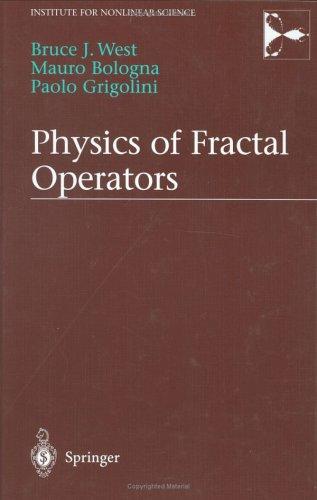
Physics of Fractal Operators
0
0
As an Amazon Associate and affiliate partner, Menrva Books earns from qualifying purchases. Learn more
Author Description
This text describes how fractal phenomena, both deterministic and random, change over time, using the fractional calculus. The intent is to identify those characteristics of complex physical phenomena that require fractional derivatives or fractional integrals to describe how the process changes over time. The discussion emphasizes the properties of physical phenomena whose evolution is best described using the fractional calculus, such as systems with long-range spatial interactions or long-time memory. In many cases, classic analytic function theory cannot serve for modeling complex phenomena; "Fractal Operators" shows how classes of less familiar functions, such as fractals, can serve as useful models in such cases. Because fractal functions, such as the Weierstrass function (long known not to have a derivative), do in fact have fractional derivatives, they can be cast as solutions to fractional differential equations. The traditional techniques for solving differential equations, including Fourier and Laplace transforms as well as Green's functions, can be generalized to fractional derivatives. Fractal Operators addresses a general strategy for understanding wave propagation through random media, the nonlinear response of complex materials, and the fluctuations of various forms of transport in heterogeneous materials. This strategy builds on traditional approaches and explains why the historical techniques fail as phenomena become more and more complicated.
Menrva's Summary
THE THESIS
This text investigates how fractal phenomena, both deterministic and random, evolve over time using the principles of fractional calculus. The author, Bruce J. West, aims to identify the characteristics of complex physical phenomena that necessitate the use of fractional derivatives or integrals to describe their temporal changes. The book focuses on systems exhibiting long-range spatial interactions or long-time memory, where classic analytic function theory proves insufficient for modeling. It demonstrates how fractal functions, which traditionally lack derivatives, can be understood as solutions to fractional differential equations, thereby extending traditional analytical techniques.
THE SCOPE MAP
- Explanation of how fractal phenomena change over time using fractional calculus.
- Identification of physical phenomena best described by fractional derivatives or integrals.
- Discussion of systems with long-range spatial interactions or long-time memory.
- Application of fractal functions, like the Weierstrass function, as models for complex phenomena.
- Generalization of traditional techniques like Fourier and Laplace transforms to fractional derivatives.
- Strategies for understanding wave propagation through random media.
- Analysis of the nonlinear response of complex materials.
- Examination of fluctuations in various forms of transport in heterogeneous materials.
THE AUTHORITY PERSPECTIVE
This work appears to be a specialized academic text aimed at researchers and advanced students in physics and mathematics. Its focus on fractal operators and fractional calculus suggests a dense, technical treatment of complex phenomena. The book's approach of extending traditional analytical methods to handle fractal behavior indicates a contribution to the theoretical understanding of systems with memory and long-range interactions. The detailed exploration of applications in wave propagation and material science points to its utility for those working in these specific fields.
Page Count:
364
Publication Date:
2011-01-01
ISBN-10:
144193054X
ISBN-13:
9781441930545
Science & Technology
Action
Non-Fiction
Science
Fractals
Mathematics
Physics
Community Tags
Similar Books