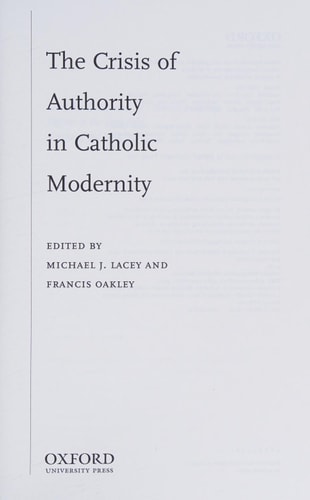
The Crisis of Authority in Catholic Modernity
0
0
As an Amazon Associate and affiliate partner, Menrva Books earns from qualifying purchases. Learn more
Author Description
One deep problem facing the Catholic church is the question of how its teaching authority is understood today. It is fairly clear that, while Rome continues to teach as if its authority were unchanged from the days before Vatican II (1962-65), the majority of Catholics - within the first-world church, at least - take a far more independent line, and increasingly understand themselves (rather than the church) as the final arbiters of decision-making, especially on ethical questions. This collection of essays explores the historical background and present ecclesial situation, explaining the dramatic shift in attitude on the part of contemporary Catholics in the U.S. and Europe. The overall purpose is neither to justify nor to repudiate the authority of the church's hierarchy, but to cast some light on: the context within which it operates, the complexities and ambiguities of the historical tradition of belief and behavior it speaks for, and the kinds of limits it confronts - consciously or otherwise. The authors do not hope to fix problems, although some of the essays make suggestions, but to contribute to a badly needed intra-Catholic dialogue without which, they believe, problems will continue to fester and solutions will remain elusive.
Menrva's Summary
THE THESIS
This collection of essays investigates the widening disconnect between the Vatican's traditional exercise of teaching authority and the increasingly autonomous decision-making processes of contemporary Catholics in the West. Edited by Francis Oakley and Michael J. Lacey, the volume draws upon historical analysis and sociological observation to examine how the post-Vatican II church navigates the tension between hierarchical mandates and individual conscience. The contributors argue that without a transparent dialogue regarding these shifting attitudes, the institutional church will continue to face significant challenges in maintaining its moral influence.
THE SCOPE MAP
What You Will Find
- Historical analysis of the evolution of Catholic teaching authority since Vatican II.
- Sociological examination of the shift toward individual ethical autonomy among Catholics in the United States and Europe.
- Comparative studies of institutional tradition versus modern practice.
- Theoretical frameworks for facilitating intra-Catholic dialogue on authority and dissent.
THE AUTHORITY PERSPECTIVE
Scholars and theologians frequently cite this work as a balanced, non-polemical resource for understanding the structural tensions within modern Catholicism. Experts highlight the text as a useful academic contribution for those studying the intersection of institutional history and contemporary religious practice.
Page Count:
392
Publication Date:
2011-04-06
Publisher:
Oxford University Press
ISBN-10:
0199778787
ISBN-13:
9780199778782
Religion
History
Sociology
Theology
Catholicism
Church
Religious Aspects
Catholic Church
Community Tags
Similar Books