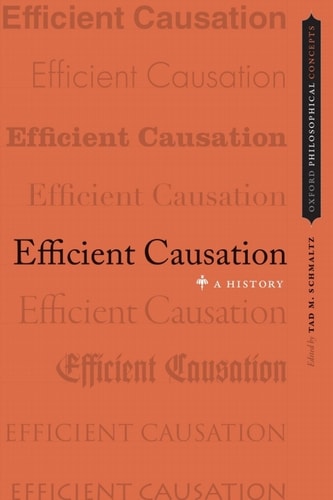
Efficient Causation: A History
0
0
As an Amazon Associate and affiliate partner, Menrva Books earns from qualifying purchases. Learn more
Author Description
Causation is now commonly supposed to involve a succession that instantiates some law-like regularity. Efficient Causation: A History examines how our modern notion developed from a very different understanding of efficient causation. This volume begins with Aristotle's initial conception of efficient causation, and then considers the transformations and reconsiderations of this conception in late antiquity, medieval and modern philosophy, ending with contemporary accounts of causation. It includes four short "Reflections" that explore the significance of the concept for literature, the history of music, the history of science, and contemporary art theory.
Menrva's Summary
THE THESIS
This volume investigates the historical evolution of the concept of efficient causation from its Aristotelian origins to its contemporary interpretation as law-like regularity. Tad M. Schmaltz, a scholar of early modern philosophy, utilizes a rigorous historical framework to trace how the understanding of causal agency shifted across late antiquity, the medieval period, and the modern era. By analyzing these philosophical transformations, the author provides a comprehensive account of how our current scientific and metaphysical assumptions regarding cause and effect were constructed over centuries of intellectual debate.
THE SCOPE MAP
What You Will Find
- A chronological analysis of efficient causation from Aristotle through contemporary philosophy.
- Examination of key shifts in causal theory during late antiquity and the medieval period.
- Four specialized reflections on the impact of causation in literature, music history, science, and art theory.
- A critical evaluation of the transition from agent-based causation to modern law-like regularity.
THE AUTHORITY PERSPECTIVE
Scholars and students of philosophy frequently identify this text as a definitive resource for understanding the conceptual history of causality. Experts highlight the academic density of the prose and the author's ability to synthesize complex metaphysical shifts into a coherent historical narrative.
Page Count:
392
Publication Date:
2014-01-01
Publisher:
Oxford University Press
ISBN-10:
0199782229
ISBN-13:
9780199782222
Science
Philosophy
Causation
Metaphysics
Academic
History & Surveys
Community Tags
Other Editions(2)
Similar Books