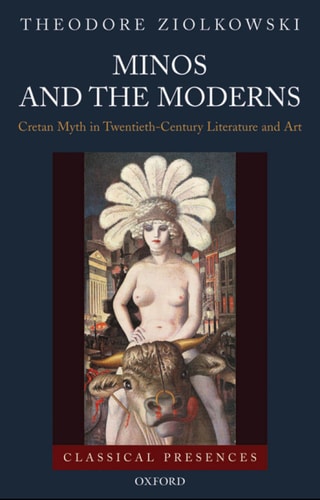
Minos and the Moderns: Cretan Myth in Twentieth-Century Literature and Art
0
0
As an Amazon Associate and affiliate partner, Menrva Books earns from qualifying purchases. Learn more
Author Description
Minos and the Moderns considers three mythological complexes that enjoyed a unique surge of interest in early twentieth-century European art and literature: Europa and the bull, the minotaur and the labyrinth, and Daedalus and Icarus. All three are situated on the island of Crete and are linked by the figure of King Minos. Drawing examples from fiction, poetry, drama, painting, sculpture, opera, and ballet, Minos and the Moderns is the first book of its kind to treat the role of the Cretan myths in the modern imagination. Beginning with the resurgence of Crete in the modern consciousness in 1900 following the excavations of Sir Arthur Evans, Theodore Ziolkowski shows how the tale of Europa-in poetry, drama, and art, but also in cartoons, advertising, and currency-was initially seized upon as a story of sexual awakening, then as a vehicle for social and political satire, and finally as a symbol of European unity. In contast, the minotaur provided artists ranging from Picasso to Dürrenmatt with an image of the artist's sense of alienation, while the labyrinth suggested to many writers the threatening sociopolitical world of the twentieth century. Ziolkowski also considers the roles of such modern figures as Marx, Nietzsche, and Freud; of travelers to Greece and Crete from Isadora Duncan to Henry Miller; and of the theorists and writers, including T. S. Eliot and Thomas Mann, who hailed the use of myth in modern literature. Minos and the Moderns concludes with a summary of the manners in which the economic, aesthetic, psychological, and anthropological revisions enabled precisely these myths to be taken up as a mirror of modern consciousness. The book will appeal to all readers interested in the classical tradition and its continuing relevance and especially to scholars of Classics and modern literatures.
Menrva's Summary
THE THESIS
This work investigates how three specific Cretan myths—Europa, the Minotaur, and Daedalus—functioned as foundational symbols for European artistic and literary expression during the twentieth century. Theodore Ziolkowski, a scholar of modern literature, utilizes a multidisciplinary approach to trace the evolution of these myths from the 1900 excavations of Sir Arthur Evans through the post-war era. By examining diverse media including poetry, drama, painting, and sculpture, the author argues that these ancient narratives provided a necessary framework for modernists to articulate complex themes of alienation, political instability, and cultural identity.
THE SCOPE MAP
What You Will Find
- Analysis of the Europa, Minotaur, and Daedalus mythic complexes.
- Examination of interdisciplinary artistic responses including opera, ballet, and advertising.
- Synthesis of intellectual influences from Marx, Nietzsche, and Freud.
- Historical context regarding the archaeological discovery of Knossos.
Scope Limits
- The study focuses primarily on European artistic and literary traditions.
- It does not provide an exhaustive catalog of every artistic depiction of these myths.
THE AUTHORITY PERSPECTIVE
Scholars of classical reception and modernism frequently cite this text for its breadth in connecting archaeological history with twentieth-century creative output. The prose is noted for its academic rigor and its ability to synthesize disparate artistic mediums into a coherent cultural narrative.
Page Count:
182
Publication Date:
2008-01-01
Publisher:
Oxford University Press
ISBN-10:
0190450673
ISBN-13:
9780190450670
English
Literary Criticism
Mythology
Greece
Art History
Modernism
Cultural History
English & College Success
Community Tags
Similar Books