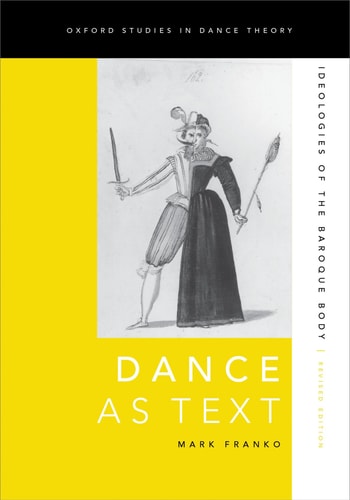
Dance as Text: Ideologies of the Baroque Body
0
0
As an Amazon Associate and affiliate partner, Menrva Books earns from qualifying purchases. Learn more
Author Description
Dance as Text: Ideologies of the Baroque Body is a historical and theoretical examination of French court ballet over a hundred-year period, beginning in 1573, that spans the late Renaissance and early baroque. Utilizing aesthetic and ideological criteria, author Mark Franko analyzes court ballet librettos, contemporary performance theory, and related commentary on dance and movement in the literature of this period. Examining the formal choreographic apparatus that characterizes late Valois and early Bourbon ballet spectacle, Franko postulates that the evolving aesthetic ultimately reflected the political situation of the noble class, which devised and performed court ballets. He shows how the body emerged from verbal theater as a self-sufficient text whose autonomy had varied ideological connotations, most important among which was the expression of noble resistance to the increasingly absolutist monarchy. Franko's analysis blends archival research with critical and cultural theory in order to resituate the burlesque tradition in its politically volatile context. Dance as Text thus provides a picture of the complex theoretical underpinnings of composite spectacle, the ideological tensions underlying experiments with autonomous dance, and finally, the subversiveness of Molière's use of court ballet traditions.
Menrva's Summary
THE THESIS
How did the evolution of French court ballet reflect the shifting political ideologies and power dynamics of the noble class during the late Renaissance and early Baroque periods? Mark Franko, a scholar in dance theory, utilizes a rigorous interdisciplinary framework to examine the intersection of performance and politics. By analyzing librettos, performance theory, and contemporary literature, he argues that the development of dance as an autonomous art form served as a vehicle for noble resistance against the rise of absolutist monarchy.
THE SCOPE MAP
What You Will Find
- A historical analysis of French court ballet spanning from 1573 to the late 17th century.
- Examination of the formal choreographic apparatus of late Valois and early Bourbon spectacles.
- Integration of archival research with critical and cultural theory to interpret movement.
- Investigation into the subversiveness of Molière's engagement with court ballet traditions.
THE AUTHORITY PERSPECTIVE
Scholars and dance historians identify this work as a foundational text for understanding the political dimensions of Baroque performance. Readers frequently note the academic density of the prose, which requires a strong background in critical theory to fully grasp the author's arguments.
Page Count:
272
Publication Date:
2015-07-28
Publisher:
Oxford University Press
ISBN-10:
0199794014
ISBN-13:
9780199794010
History
Ballet
Art History
Cultural Theory
Dance_france
Dance
European History
Performance Studies
Community Tags
Other Editions(2)
Similar Books