
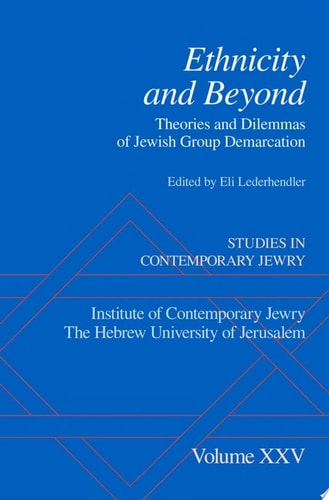
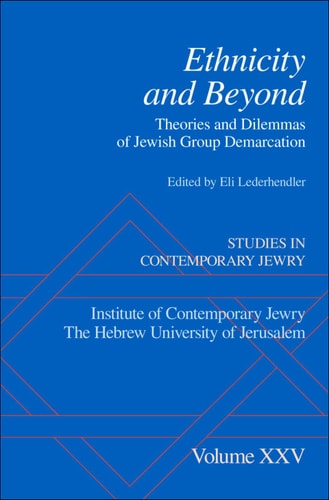
Ethnicity and Beyond: Theories and Dilemmas of Jewish Group Demarcation
0
0
As an Amazon Associate and affiliate partner, Menrva Books earns from qualifying purchases. Learn more
Author Description
Volume XXV of the distinguished annual Studies in Contemporary Jewry explores new understandings and approaches to Jewish "ethnicity." In current parlance regarding multicultural diversity, Jews are often considered to belong socially to the "majority," whereas "otherness" is reserved for "minorities." But these group labels and their meanings have changed over time. This volume analyzes how "ethnic," "ethnicity," and "identity" have been applied to Jews, past and present, individually and collectively.Most of the symposium papers on the ethnicity of Jewish people and the social groups they form draw heavily on the case of American Jews, while others offer wider geographical perspectives. Contributors address ex-Soviet Jews in Philadelphia, comparing them to a similar population in Tel Aviv; Communism and ethnicity; intermarriage and group blending; American Jewish dialogue; and German Jewish migration in the interwar decades. Leading academics, employing a variety of social scientific methods and historical paradigms, propose to enhance the clarity of definitions used to relate "ethnic identity" to the Jews. They point to ethnic experience in a variety of different social manifestations: language use in social context, marital behavior across generations, spatial and occupational differentiation in relation to other members of society, and new immigrant communities as sub-ethnic units within larger Jewish populations. They also ponder the relevance of individual experience and preference as compared to the weight of larger socializing factors.Taken as a whole, this work offers revisionist views on the utility of terms like "Jewish ethnicity" that were given wider scope by scholars in the 1960s, '70s, and '80s.
Menrva's Summary
THE THESIS
This volume investigates the evolving conceptual frameworks and sociological dilemmas surrounding the classification of Jewish identity as an ethnic category within modern multicultural discourse. Editor Eli Lederhendler compiles a series of scholarly papers that challenge traditional definitions of Jewishness, examining how historical shifts and social pressures have altered the perception of Jews as either a majority or a minority group. The contributors utilize diverse social scientific methodologies to interrogate the utility of ethnic labeling in both historical and contemporary contexts.
THE SCOPE MAP
What You Will Find
- Comparative analysis of Jewish immigrant populations in Philadelphia and Tel Aviv.
- Historical examination of German Jewish migration during the interwar period.
- Sociological study of intermarriage, language usage, and occupational differentiation.
- Theoretical critique of ethnic identity models established by scholars in the 1960s through the 1980s.
THE AUTHORITY PERSPECTIVE
Scholars and students of sociology and Jewish history frequently cite this volume as a critical resource for understanding the complexities of group demarcation. Experts highlight the text's academic rigor and its success in providing a nuanced, revisionist perspective on identity politics.
Page Count:
256
Publication Date:
2011-03-08
Publisher:
Oxford University Press
ISBN-10:
0199793492
ISBN-13:
9780199793495
History
Jewish Studies
Jews identity
Sociology
Jews europe
United States
Ethnicity
Community Tags
Other Editions(3)
Similar Books









Reader Comments
Share Your Thoughts
No comments yet. Be the first to share your thoughts!