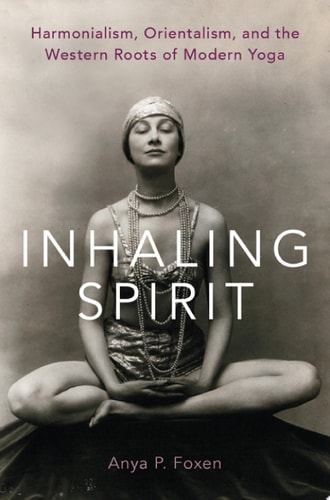
Inhaling Spirit: Harmonialism, Orientalism, and the Western Roots of Modern Yoga
0
0
As an Amazon Associate and affiliate partner, Menrva Books earns from qualifying purchases. Learn more
Author Description
Recent scholarship has shown that modern postural yoga is the outcome of a complex process of transcultural exchange and syncretism. This book doubles down on those claims and digs even deeper, looking to uncover the disparate but entangled roots of modern yoga practice. Anya Foxen shows that some of what we call yoga, especially in North America and Europe, is genealogically only slightly related to pre-modern Indian yoga traditions. Rather, it is equally, if not more so, grounded in Hellenistic theories of the subtle body, Western esotericism and magic, pre-modern European medicine, and late-nineteenth-century women's wellness programs. The book begins by examining concepts arising out of Greek philosophy and religion, including Pythagoreanism, Stoicism, Neo-Platonism, Galenic medicine, theurgy, and other cultural currents that have traditionally been categorized as "Western esotericism," as well as the more recent examples which scholars of American traditions have labeled "metaphysical religion." Marshaling these under the umbrella category of "harmonialism," Foxen argues that they represent a history of practices that were gradually subsumed into the language of yoga.Orientalism and gender become important categories of analysis as this narrative moves into the nineteenth century. Women considerably outnumber men in all studies of yoga except those conducted in India, and modern anglophone yoga exhibits important continuities with women's physical culture, feminist reform, and white women's engagement with Orientalism. Foxen's study allows us to recontextualize the peculiarities of American yoga--its focus on aesthetic representation, its privileging of bodily posture and unsystematic incorporation of breathwork, and above all its overwhelmingly white female demographic. In this context it addresses the ongoing conversation about cultural appropriation within the yoga community.
Menrva's Summary
THE THESIS
This book investigates the historical and cultural origins of modern postural yoga, questioning the extent to which it is rooted in pre-modern Indian traditions versus Western esoteric and metaphysical frameworks. Anya P. Foxen, a scholar of religious studies, utilizes a multidisciplinary approach to trace the genealogy of yoga practices in North America and Europe. She argues that modern yoga is a product of transcultural syncretism, heavily influenced by Hellenistic philosophy, nineteenth-century women's wellness movements, and Western occultism, which she categorizes under the term 'harmonialism.'
THE SCOPE MAP
What You Will Find
- Analysis of Hellenistic theories including Pythagoreanism, Stoicism, and Neo-Platonism.
- Examination of the role of gender and white women's physical culture in the development of yoga.
- Discussion of the intersection between Orientalism and the adoption of Eastern practices in the West.
- A framework for understanding yoga as a form of 'metaphysical religion.'
Scope Limits
- The text does not provide a comprehensive history of pre-modern Indian yoga traditions.
- It does not focus on the physiological benefits of yoga postures from a medical or scientific perspective.
THE AUTHORITY PERSPECTIVE
Scholars and readers recognize this work as a significant contribution to the critical study of modern yoga, particularly for its focus on the demographic and cultural shifts in Western practice. The text is noted for its academic rigor and its ability to synthesize complex historical threads into a coherent argument regarding cultural appropriation and syncretism.
Page Count:
336
Publication Date:
2020-01-01
Publisher:
Oxford University Press
ISBN-10:
0190082755
ISBN-13:
9780190082758
Religion
History
Activities & Sports
Gender Studies
Yoga
Physical fitness
Exercise
Hatha yoga
Special Topics
Womens Health
Community Tags
Similar Books