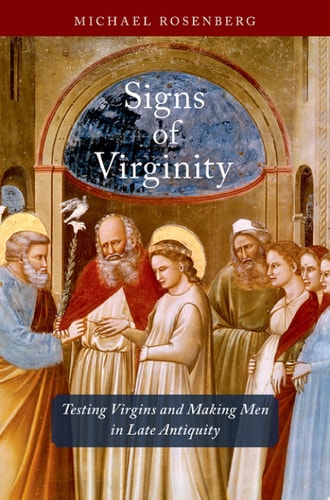
Signs of Virginity: Testing Virgins and Making Men in Late Antiquity
0
0
As an Amazon Associate and affiliate partner, Menrva Books earns from qualifying purchases. Learn more
Author Description
Although the theme of bloodied nuptial sheets seems pervasive in western culture, its association with female virginity is uniquely tied to a brief passage in the book of Deuteronomy detailing the procedure for verifying a young woman's purity; it seldom, if ever, appears outside of Abrahamic traditions. In Signs of Virginity, Michael Rosenberg examines the history of virginity testing in Judaism and early Christianity, and the relationship of these tests to a culture that encourages male sexual violence. Deuteronomy's violent vision of virginity has held sway in Jewish and Christian circles more or less ever since. However, Rosenberg points to two authors-the rabbinic collective that produced the Babylonian Talmud and the early Christian thinker Augustine of Hippo-who, even as they perpetuate patriarchal assumptions about female virginity, nonetheless attempt to subvert the emphasis on sexual dominance bequeathed to them by Deuteronomy. Unlike the authors of earlier Rabbinic and Christian texts, who modified but fundamentally maintained and even extended the Deuteronomic ideal, the Babylonian Talmud and Augustine both construct alternative models of female virginity that, if taken seriously, would utterly reverse cultural ideals of masculinity. Indeed this vision of masculinity as fundamentally gentle, rather than characterized by brutal and violent sexual behavior, fits into a broader idealization of masculinity propagated by both authors, who reject what Augustine called a "lust for dominance" as a masculine ideal.
Menrva's Summary
THE THESIS
This book investigates the historical origins and theological evolution of virginity testing within Abrahamic traditions, specifically questioning how early Jewish and Christian thinkers navigated the violent mandates found in Deuteronomy. Michael Rosenberg, a scholar of religion, utilizes a rigorous analysis of the Babylonian Talmud and the writings of Augustine of Hippo to demonstrate how these figures attempted to decouple female purity from the cultural acceptance of male sexual violence. By examining these texts, the author argues that these specific thinkers proposed alternative models of masculinity that prioritized gentleness over the traditional lust for dominance.
THE SCOPE MAP
What You Will Find
- Historical analysis of the Deuteronomic legal framework regarding virginity.
- Comparative study of the Babylonian Talmud and Augustinian theology.
- Examination of the intersection between sexual violence and religious law in Late Antiquity.
Scope Limits
- The study does not provide an exhaustive survey of all early Christian or Jewish sects.
- The analysis focuses primarily on the specific texts of the Talmud and Augustine rather than broader sociological data from the period.
THE AUTHORITY PERSPECTIVE
Scholars in the fields of religious history and gender studies recognize this work as a significant contribution to understanding the evolution of patriarchal norms in early religious texts. Readers frequently note the academic density of the prose and the author's ability to synthesize complex theological arguments with historical context.
Page Count:
328
Publication Date:
2018-01-01
Publisher:
Oxford University Press
ISBN-10:
0190845910
ISBN-13:
9780190845919
Religion
History
Late Antiquity
Bibles
Special Topics
Gender Studies
Judaism
Christianity
Community Tags
Similar Books