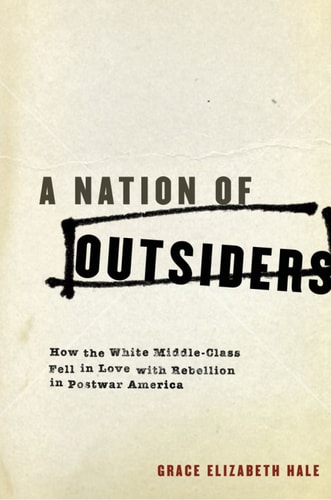
A Nation of Outsiders: How the White Middle Class Fell in Love with Rebellion in Postwar America
0
0
As an Amazon Associate and affiliate partner, Menrva Books earns from qualifying purchases. Learn more
Author Description
At mid-century, Americans increasingly fell in love with characters like Holden Caulfield in Catcher in the Rye and Marlon Brando's Johnny in The Wild One, musicians like Elvis Presley and Bob Dylan, and activists like the members of the Student Nonviolent Coordinating Committee. These emotions enabled some middle-class whites to cut free of their own histories and identify with those who, while lacking economic, political, or social privilege, seemed to possess instead vital cultural resources and a depth of feeling not found in "grey flannel" America. In this wide-ranging and vividly written cultural history, Grace Elizabeth Hale sheds light on why so many white middle-class Americans chose to re-imagine themselves as outsiders in the second half of the twentieth century and explains how this unprecedented shift changed American culture and society. Love for outsiders launched the politics of both the New Left and the New Right. From the mid-sixties through the eighties, it flourished in the hippie counterculture, the back-to-the-land movement, the Jesus People movement, and among fundamentalist and Pentecostal Christians working to position their traditional isolation and separatism as strengths. It changed the very meaning of "authenticity" and "community." Ultimately, the romance of the outsider provided a creative resolution to an intractable mid-century cultural and political conflict-the struggle between the desire for self-determination and autonomy and the desire for a morally meaningful and authentic life.
Menrva's Summary
THE THESIS
This book investigates why the white middle class in postwar America increasingly adopted the identity of the outsider as a central cultural and political framework. Grace Elizabeth Hale, a professor of history, utilizes a broad array of cultural artifacts—from literature and film to music and political movements—to argue that this identification was a strategic response to the tensions of the mid-twentieth century. By analyzing the shift from conformity to rebellion, Hale demonstrates how the romanticization of the marginalized became a defining feature of both the New Left and the New Right.
THE SCOPE MAP
What You Will Find
- Analysis of mid-century cultural icons including Holden Caulfield, Marlon Brando, Elvis Presley, and Bob Dylan.
- Examination of diverse movements ranging from the hippie counterculture and back-to-the-land groups to the Jesus People and fundamentalist Christians.
- Historical investigation into the changing definitions of authenticity and community in American society.
- Exploration of how the desire for self-determination and moral meaning fueled political shifts from the 1960s through the 1980s.
THE AUTHORITY PERSPECTIVE
Scholars and critics frequently cite this work as a significant contribution to the understanding of postwar American identity politics. Readers often note the accessibility of the prose despite the academic rigor and the breadth of the cultural analysis provided.
Page Count:
392
Publication Date:
2011-01-01
Publisher:
Oxford University Press
ISBN-10:
0199792925
ISBN-13:
9780199792924
Politics
History
Counterculture
Cultural History
Dissenters
Sociology
American Studies
Whites
American History
Special Topics
United States
Community Tags
Similar Books