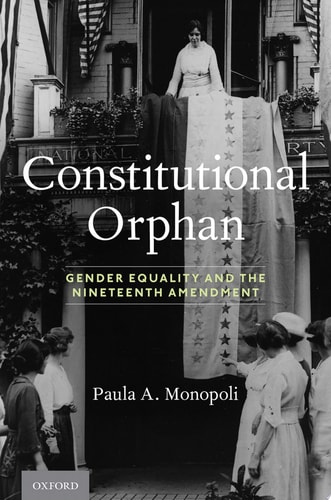
Constitutional Orphan: Gender Equality and the Nineteenth Amendment
0
0
As an Amazon Associate and affiliate partner, Menrva Books earns from qualifying purchases. Learn more
Author Description
In Constitutional Orphan, Professor Paula Monopoli explores the significant role of former suffragists in the constitutional development of the Nineteenth Amendment -- the woman suffrage amendment ratified in 1920. She sheds new light on the connection between the suffragists as institutional actors in civil society and the emergence of a "thin" conception of the Nineteenth Amendment as a mere nondiscrimination in voting rule, rather than a robust equality norm. In this compelling legal history, Monopoli illuminates how the Nineteenth had implications for federalism, women's citizenship and the definition of equality, as well as how gender, race and class intersect to affect our constitutional development.Monopoli explores the choice by both the National Woman's Party and the National American Woman Suffrage Association to turn away from African American suffragists who were denied the vote even after ratification of the Nineteenth Amendment. Using original sources, legislative history and case analysis, she develops a persuasive theory connecting that moral and strategic failure to the emergence of a narrow interpretation of the amendment. Monopoli also evaluates the impact of class divisions among former suffragist allies. These divisions around support for the NWP's Equal Rights Amendment, found social feminists opposing that "blanket" amendment for fear of its impact on the constitutional validity of protective labor legislation for working-class women.Monopoli details how many state courts, left without federal enforcement legislation to guide them, used strict construction to cabin the emergence of a more robust interpretation of the Nineteenth Amendment, as a broad equality norm. She concludes with an examination of new legal scholarship that suggests ways in which such a robust understanding of the Nineteenth Amendment could be used today to expand gender equality. In this compelling legal history, Monopoli illuminates how gender, race and class intersect to affect our constitutional development.
Menrva's Summary
THE THESIS
This book investigates why the Nineteenth Amendment evolved into a narrow nondiscrimination rule rather than a comprehensive equality norm. Paula A. Monopoli, a professor of law, utilizes original archival sources, legislative records, and judicial case analysis to examine the strategic and moral failures of early suffragist organizations. She argues that the exclusion of African American women and internal class divisions among suffragists directly influenced the restrictive legal interpretation of the amendment in the decades following its ratification.
THE SCOPE MAP
What You Will Find
- Analysis of the National Woman's Party and the National American Woman Suffrage Association strategies.
- Examination of the intersectionality of race, class, and gender in constitutional development.
- Evaluation of state court rulings and the impact of the absence of federal enforcement legislation.
- Discussion of the Equal Rights Amendment and its relationship to protective labor legislation.
Scope Limits
- The text focuses primarily on the legal and institutional history of the amendment rather than a comprehensive biography of individual suffragists.
- It does not provide an exhaustive survey of all state-level voting rights litigation post-1920.
THE AUTHORITY PERSPECTIVE
Legal scholars and historians recognize this work as a significant contribution to the understanding of constitutional interpretation and the limitations of the Nineteenth Amendment. Readers frequently note the academic density of the prose and the author's meticulous use of primary source materials to challenge traditional narratives of suffrage history.
Page Count:
256
Publication Date:
2020-09-11
Publisher:
Oxford University Press
ISBN-10:
0190092793
ISBN-13:
9780190092795
History
Constitutional Law
Legal History
United States
Gender Studies
Professional Career & Trade
Womens Studies
Community Tags
Similar Books