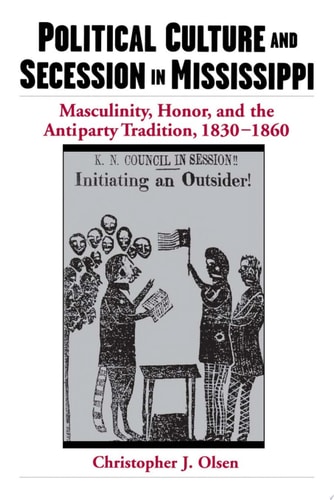
Political Culture and Secession in Mississippi: Masculinity, Honor, and the Antiparty Tradition, 1830-1860
0
0
As an Amazon Associate and affiliate partner, Menrva Books earns from qualifying purchases. Learn more
Author Description
This groundbreaking study of the politics of secession combines traditional political history with current work in anthropology and gender and ritual studies. Christopher J. Olsen has drawn on local election returns, rural newspapers, manuscripts, and numerous county records to sketch a new picture of the intricate and colorful world of local politics. In particular, he demonstrates how the move toward secession in Mississippi was deeply influenced by the demands of masculinity within the state's antiparty political culture. Face-to-face relationships and personal reputations, organized around neighborhood networks of friends and extended kin, were at the heart of antebellum Mississippi politics. The intimate, public nature of this tradition allowed voters to assess each candidate's individual status and fitness for public leadership. Key virtues were independence and physical courage, as well as reliability and loyalty to the community, and the political culture offered numerous chances to demonstrate all of these (sometimes contradictory) qualities. Like dueling and other male rituals, voting and running for office helped set the boundaries of class and power. They also helped mediate the conflicts between nineteenth-century American egalitarianism, democracy, and geographic mobility, and the South's exaggerated patriarchal hierarchy, sustained by honor and slavery. The political system, however, functioned effectively only as long as it remained a personal exercise between individuals, divorced from the anonymity of institutional parties. This antiparty tradition eliminated the distinction between men as individuals and as public representatives, which caused them to assess and interpret all political events and rhetoric in a personal manner. The election of 1860 and success of the Republicans' antisouthern, free soil program, therefore, presented an "insulting" challenge to personal, family, and community honor. As Olsen shows in detail, the sectional controvers
Menrva's Summary
THE THESIS
This study investigates how the intersection of masculinity, honor, and an antiparty political tradition in Mississippi directly influenced the state's decision to secede from the Union. Christopher J. Olsen, a historian specializing in nineteenth-century American politics, utilizes a synthesis of traditional political history and anthropological methods to examine the period between 1830 and 1860. By analyzing local election returns, personal manuscripts, and rural newspapers, the author argues that the personal nature of antebellum politics made the political shifts of 1860 feel like a direct affront to individual and community honor.
THE SCOPE MAP
What You Will Find
- Analysis of the antiparty political culture in Mississippi from 1830 to 1860.
- Examination of male rituals, including dueling, as mechanisms for establishing social and political status.
- Exploration of the tension between democratic egalitarianism and the hierarchical structure of a slave-holding society.
- Discussion of how personal reputation and neighborhood networks dictated political outcomes.
Scope Limits
- The study focuses primarily on Mississippi and does not provide a comprehensive analysis of secessionist movements in other Southern states.
- The text does not cover the military or strategic aspects of the Civil War, focusing instead on the political culture leading up to the conflict.
THE AUTHORITY PERSPECTIVE
Historians frequently cite this work for its innovative application of gender studies to the political history of the antebellum South. Scholars note that the prose is accessible while maintaining the rigor expected of academic historical analysis.
Page Count:
276
Publication Date:
2000-01-01
Publisher:
Oxford University Press
ISBN-10:
0190284994
ISBN-13:
9780190284992
History
American History
Gender Studies
Southern History
United States
Secession
Community Tags
Similar Books

Reader Comments
Share Your Thoughts
No comments yet. Be the first to share your thoughts!