The Last Ghetto: An Everyday History of Theresienstadt
0
0
As an Amazon Associate and affiliate partner, Menrva Books earns from qualifying purchases. Learn more
Author Description
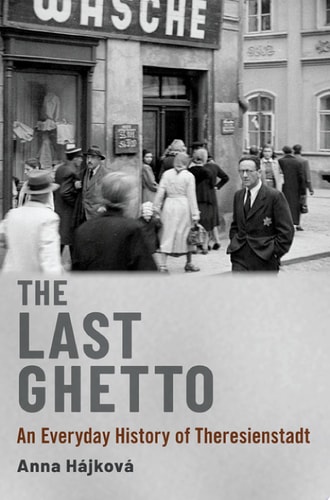
Terezín, as it was known in Czech, or Theresienstadt as it was known in German, was operated by the Nazis between November 1941 and May 1945 as a transit ghetto for Central and Western European Jews before their deportation for murder in the East. Terezín was the last ghetto to be liberated, one day after the end of World War II.The Last Ghetto is the first in-depth analytical history of a prison society during the Holocaust. Rather than depict the prison society which existed within the ghetto as an exceptional one, unique in kind and not understandable by normal analytical methods, Anna Hájková argues that such prison societies that developed during the Holocaust are best understood as simply other instances of the societies human beings create under normal circumstances. Challenging conventional claims of Holocaust exceptionalism, Hájková insists instead that we ought to view the Holocaust with the same analytical tools as other historical events.The prison society of Terezín produced its own social hierarchies under which seemingly small differences among prisoners (of age, ethnicity, or previous occupation) could determine whether one ultimately lived or died. During the three and a half years of the camp's existence, prisoners created their own culture and habits, bonded, fell in love, and forged new families. Based on extensive archival research in nine languages and on empathetic reading of victim testimonies, The Last Ghetto is a transnational, cultural, social, gender, and organizational history of Terezín, revealing how human society works in extremis and highlighting the key issues of responsibility, agency and its boundaries, and belonging.
Menrva's Summary
THE THESIS
This book investigates whether the prison society of the Theresienstadt ghetto should be viewed as an exceptional, incomprehensible phenomenon or as a social structure governed by the same human dynamics found in normal circumstances. Anna Hájková, a historian specializing in Holocaust studies, utilizes extensive archival research across nine languages to challenge the concept of Holocaust exceptionalism. By applying standard analytical tools to the ghetto's internal social hierarchies, she argues that the camp functioned as a complex society where agency, relationships, and status dictated survival outcomes.
THE SCOPE MAP
What You Will Find
- A comprehensive social and organizational history of the Theresienstadt transit ghetto from 1941 to 1945.
- Analysis of internal hierarchies based on ethnicity, age, and pre-war occupation.
- Examination of human behavior, romantic relationships, and cultural formation under extreme duress.
- A transnational perspective incorporating diverse victim testimonies and archival records.
Scope Limits
- The book does not focus on the military operations of the war outside the ghetto walls.
- It does not provide a traditional chronological narrative of the Holocaust as a whole, but rather focuses specifically on the internal mechanics of Terezín.
THE AUTHORITY PERSPECTIVE
Scholars and historians recognize this work as a significant contribution to Holocaust historiography for its rigorous application of sociological analysis to a site of mass trauma. Readers frequently note the academic density of the prose and the author's meticulous attention to the nuances of prisoner agency and social stratification.
Page Count:
376
Publication Date:
2020-11-19
Publisher:
Oxford University Press
ISBN-10:
0190051779
ISBN-13:
9780190051778
Politics
History
World politics
Europe
European History
HistoryTheresienstadt Concentration camp
Social History
Theresienstadt Concentration camp
Politics & Government
New Used & Rental Textbooks
Jewish
20th Century
Sociology
World
World War
Community Tags
Similar Books