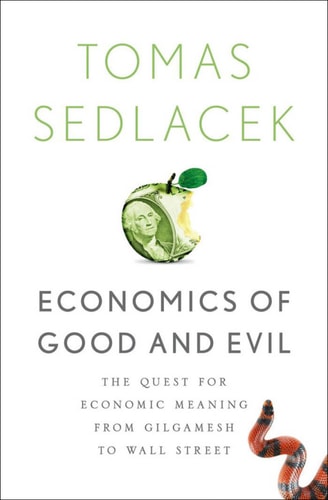
Economics of Good and Evil: The Quest for Economic Meaning from Gilgamesh to Wall Street
0
0
As an Amazon Associate and affiliate partner, Menrva Books earns from qualifying purchases. Learn more
Author Description
Tomas Sedlacek has shaken the study of economics as few ever have. Named one of the "Young Guns" and one of the "five hot minds in economics" by the Yale Economic Review, he serves on the National Economic Council in Prague, where his provocative writing has achieved bestseller status. How has he done it? By arguing a simple, almost heretical proposition: economics is ultimately about good and evil.In The Economics of Good and Evil, Sedlacek radically rethinks his field, challenging our assumptions about the world. Economics is touted as a science, a value-free mathematical inquiry, he writes, but it's actually a cultural phenomenon, a product of our civilization. It began within philosophy--Adam Smith himself not only wrote The Wealth of Nations, but also The Theory of Moral Sentiments--and economics, as Sedlacek shows, is woven out of history, myth, religion, and ethics. "Even the most sophisticated mathematical model," Sedlacek writes, "is, de facto, a story, a parable, our effort to (rationally) grasp the world around us." Economics not only describes the world, but establishes normative standards, identifying ideal conditions. Science, he claims, is a system of beliefs to which we are committed. To grasp the beliefs underlying economics, he breaks out of the field's confines with a tour de force exploration of economic thinking, broadly defined, over the millennia. He ranges from the epic of Gilgamesh and the Old Testament to the emergence of Christianity, from Descartes and Adam Smith to the consumerism in Fight Club. Throughout, he asks searching meta-economic questions: What is the meaning and the point of economics? Can we do ethically all that we can do technically? Does it pay to be good?Placing the wisdom of philosophers and poets over strict mathematical models of human behavior, Sedlacek's groundbreaking work promises to change the way we calculate economic value.
Menrva's Summary
THE THESIS
This book investigates the core question of whether economics can be understood as a value-free mathematical science or if it is fundamentally a cultural and ethical construct rooted in human history. Tomas Sedlacek, a prominent economist and advisor to the National Economic Council in Prague, argues that modern economic theory has drifted away from its philosophical origins. By synthesizing historical, religious, and literary perspectives, he posits that economic models are essentially narratives that reflect our collective moral beliefs about good and evil.
THE SCOPE MAP
What You Will Find
- A historical survey of economic thought spanning from the Epic of Gilgamesh and the Old Testament to modern consumer culture.
- An analysis of the philosophical foundations of economics, specifically referencing Adam Smith and the transition from moral philosophy to mathematical modeling.
- A critique of the assumption that economics is a purely objective, value-free science.
- Meta-economic inquiries into the ethical implications of technical economic decision-making.
THE AUTHORITY PERSPECTIVE
Experts and readers frequently note that this text challenges the traditional boundaries of the field by integrating humanities with quantitative analysis. The prose is often described as accessible yet intellectually dense, serving as a provocative departure from standard economic textbooks.
Page Count:
365
Publication Date:
2011-01-01
Publisher:
Oxford University Press
ISBN-10:
0199831904
ISBN-13:
9780199831906
Economics
Philosophy
Non-Fiction
History
Economics history
Ethics
Principles of Macroeconomics
Community Tags
Similar Books




Reader Comments
Share Your Thoughts
No comments yet. Be the first to share your thoughts!