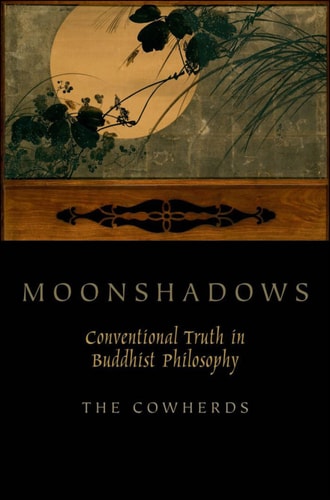
Moonshadows: Conventional Truth in Buddhist Philosophy
0
0
As an Amazon Associate and affiliate partner, Menrva Books earns from qualifying purchases. Learn more
Author Description
The doctrine of the two truths--a conventional truth and an ultimate truth--is central to Buddhist metaphysics and epistemology. The two truths (or two realities), the distinction between them, and the relation between them is understood variously in different Buddhist schools and is of special importance to the Madhyamaka school. The fundamental ideas are articulated with particular force by Nagarjuna (2nd--3rd century CE) who famously claims that the two truths are identical to one another, and yet distinct. One of the most influential interpretations of Nagarjuna's difficult doctrine derives from the commentary of Candrakirti (6th century CE). While much attention has been devoted to explaining the nature of the ultimate truth in view of its special soteriological role, less has been paid to understanding the nature of conventional truth, which is often described as "deceptive," "illusion," or "truth for fools." But conventional truth is nonetheless truth. This book therefore asks, "what is true about conventional truth?" and "What are the implications of an understanding of conventional truth for our lives?"
Menrva's Summary
THE THESIS
This work investigates the ontological and epistemological status of conventional truth within the framework of Madhyamaka Buddhist philosophy. The Cowherds, a collective of scholars specializing in Buddhist thought, analyze the historical and philosophical nuances of the two-truths doctrine. By examining the foundational texts of Nagarjuna and the commentaries of Candrakirti, the authors seek to clarify how conventional reality functions as a legitimate truth rather than merely an illusion. The book argues for a robust understanding of conventional truth that bridges the gap between metaphysical theory and practical application in daily life.
THE SCOPE MAP
What You Will Find
- A detailed analysis of the Madhyamaka school's interpretation of the two-truths doctrine.
- Comparative study of Nagarjuna's original claims and Candrakirti's subsequent commentary.
- Philosophical inquiry into the nature of deception, illusion, and truth in Buddhist metaphysics.
- Practical implications of conventional truth for ethical and cognitive engagement with the world.
THE AUTHORITY PERSPECTIVE
Scholars and students of Buddhist philosophy regard this text as a rigorous contribution to the study of Madhyamaka thought. Readers frequently note the academic density of the prose, which is intended for those already familiar with the foundational tenets of Buddhist metaphysics.
Page Count:
263
Publication Date:
2010-01-01
Publisher:
Oxford University Press
ISBN-10:
019983086X
ISBN-13:
9780199830862
Philosophy
Religion
Buddhist Philosophy
Buddhism
Buddhist
Epistemology
Truth
Metaphysics
Community Tags
Similar Books