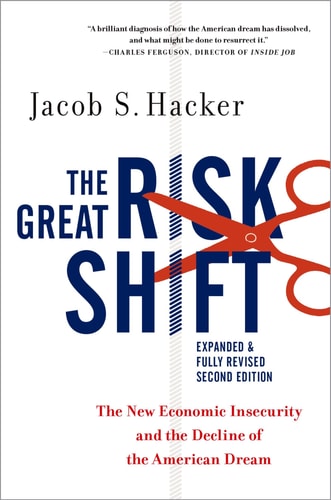
The Great Risk Shift: The New Economic Insecurity and the Decline of the American Dream
0
0
As an Amazon Associate and affiliate partner, Menrva Books earns from qualifying purchases. Learn more
Author Description
America's leaders say the economy is strong and getting stronger. But the safety net that once protected us is fast unraveling. With retirement plans in growing jeopardy while health coverage erodes, more and more economic risk is shifting from government and business onto the fragile shoulders of the American family. In The Great Risk Shift, Jacob S. Hacker lays bare this unsettling new economic climate, showing how it has come about, what it is doing to our families, and how we can fight back. Behind this shift, he contends, is the Personal Responsibility Crusade, eagerly embraced by corporate leaders and Republican politicians who speak of a nirvana of economic empowerment, an "ownership society" in which Americans are free to choose. But as Hacker reveals, the result has been quite different: a harsh new world of economic insecurity, in which far too many Americans are free to lose. The book documents how two great pillars of economic security--the family and the workplace--guarantee far less financial stability than they once did. The final leg of economic support--the public and private benefits that workers and families get when economic disaster strikes--has dangerously eroded as political leaders and corporations increasingly cut back protections of our health care, our income security, and our retirement pensions. Blending powerful human stories, big-picture analysis, and compelling ideas for reform, this remarkable volume will hit a nerve, serving as a rallying point in the vital struggle for economic security in an increasingly uncertain world.
Menrva's Summary
THE THESIS
This book investigates the systematic erosion of the American economic safety net and the resulting transfer of financial risk from institutions to individual households. Jacob S. Hacker, a political scientist and expert in public policy, utilizes historical data and economic analysis to argue that the 'Personal Responsibility Crusade' has dismantled traditional pillars of stability. He contends that the decline of employer-provided benefits and public protections has created a precarious environment where families are increasingly vulnerable to financial catastrophe.
THE SCOPE MAP
What You Will Find
- Analysis of the transition from institutional security to individual risk management
- Examination of the decline in employer-sponsored health coverage and retirement pensions
- Critique of the 'ownership society' political framework
- Proposed policy reforms to restore economic stability for the American workforce
THE AUTHORITY PERSPECTIVE
Experts and policy analysts frequently cite this work as a foundational text for understanding the structural causes of middle-class economic anxiety. Readers often note the clarity of the author's arguments despite the dense nature of the economic data presented.
Page Count:
244
Publication Date:
2006-01-01
Publisher:
Oxford University Press
ISBN-10:
0199840091
ISBN-13:
9780199840090
Economics
Politics
United States
Sociology
Public Policy
American History