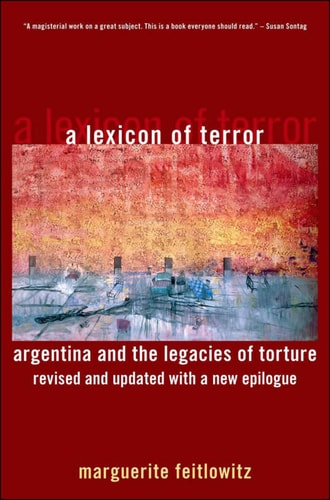
A Lexicon of Terror: Argentina and the Legacies of Torture
0
0
As an Amazon Associate and affiliate partner, Menrva Books earns from qualifying purchases. Learn more
Author Description
"We were all out in la charca, and there they were, coming over the ridge, a battalion ready for war, against a schoolhut full of children." Tanks roaring over farmlands, pregnant mothers tortured, their babies stolen and sold on the black market, homes raided in the dead of night, ordinary citizens kidnapped and never seen again--such were the horrors of Argentina's Dirty War. Now, in A Lexicon of Terror, Marguerite Feitlowitz fully exposes the nightmare of sadism, paranoia, and deception the military dictatorship unleashed on the Argentine people, a nightmare that would claim over 30,000 civilians from 1976 to 1983 and whose leaders were recently issued warrants by a Spanish court for the crime of genocide. Feitlowitz explores the perversion of language under state terrorism, both as it's used to conceal and confuse ("The Parliament must be disbanded to rejuvenate democracy") and to domesticate torture and murder. Thus, citizens kidnapped and held in secret concentration camps were "disappeared"; torture was referred to as "intensive therapy"; prisoners thrown alive from airplanes over the ocean were called "fish food." Based on six years of research and moving interviews with peasants, intellectuals, activists, and bystanders, A Lexicon of Terror examines the full impact of this catastrophic period from its inception to the present, in which former torturers, having been pardoned and released from prison, live side by side with those they tortured. Passionately written and impossible to put down, Feitlowitz shows us both the horror of the war and the heroism of those who resisted and survived--their courage, their endurance, their eloquent refusal to be dehumanized in the face of torments even Dante could not have imagined.
Menrva's Summary
THE THESIS
This work investigates how the Argentine military dictatorship utilized the perversion of language to institutionalize state terrorism and conceal the systematic torture and disappearance of 30,000 civilians. Marguerite Feitlowitz, a scholar and researcher, synthesizes six years of field research, including interviews with survivors, activists, and witnesses, to analyze the psychological and political mechanisms of the Dirty War. The book argues that the regime's linguistic manipulation—redefining murder as 'therapy' and kidnapping as 'disappearance'—was a critical tool for domesticating violence and maintaining control over the populace. By examining the period from 1976 to 1983 and its aftermath, the author provides a framework for understanding how state-sponsored terror persists in the collective memory of a nation.
THE SCOPE MAP
What You Will Find
- An analysis of the linguistic strategies used by the Argentine military to sanitize state-sponsored violence.
- Historical documentation of the 'Dirty War' period, covering the years 1976 to 1983.
- Primary source interviews with survivors, intellectuals, and human rights activists.
- A study of the long-term societal impact of impunity and the coexistence of former torturers and victims.
THE AUTHORITY PERSPECTIVE
Experts and historians frequently cite this work as a foundational text for understanding the intersection of political rhetoric and state-sponsored human rights abuses. Readers often note the chilling precision of the author's analysis, which provides a rigorous examination of how language can be weaponized to facilitate genocide.
Page Count:
409
Publication Date:
1999-01-01
Publisher:
Oxford University Press
ISBN-10:
0199840377
ISBN-13:
9780199840373
History
American History
Human rights
Sociology
Community Tags
Other Editions(3)
Similar Books















Reader Comments
Share Your Thoughts
No comments yet. Be the first to share your thoughts!