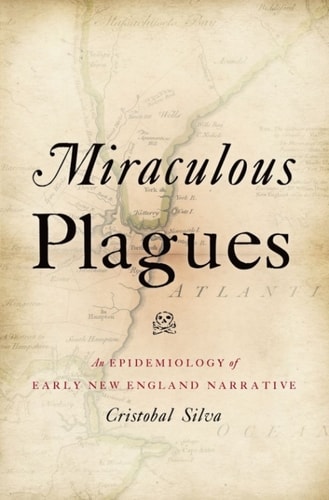
Miraculous Plagues: An Epidemiology of Early New England Narrative
0
0
As an Amazon Associate and affiliate partner, Menrva Books earns from qualifying purchases. Learn more
Author Description
In the summer of 1629, John Winthrop described a series of epidemics that devastated Native American populations along the eastern seaboard of New England as a "miraculous plague." Winthrop was struck by the providential nature of these waves of disease, which contributed neatly to the settlers' justifications for colonial expansion. Taking Winthrop's phrase as its cornerstone, Miraculous Plagues reimagines New England's literary history by tracing seventeenth- and early eighteenth-century epidemics alongside events including early migration, the Antinomian controversy, the evolution of the halfway covenant and jeremiad, and Boston's 1721 inoculation controversy. Moving beyond familiar histories of New World epidemics (often referred to as the "virgin soil" model), Cristobal Silva identifies epidemiology as a generic category with specialized forms and conventions. Epidemiology functions as both subject and method in Silva's argument, as he details narratives that represent modes of infection, population distribution, and immunity. He considers how regional and generational patterns of illness affected the perception of communal identity, and he analyzes the translation of epidemic events into narrative and generic terms, providing scholars a new way to conceptualize the relationship between immunology and ideology. Closing with a discussion of the HIV/AIDS epidemic, Miraculous Plagues underscores the portability of its insights into the geopolitics of medicine. Just as epidemiology aided in transforming colonial America, it continues to influence questions of geography, community, and identity that are bound up in global health practices today.
Menrva's Summary
THE THESIS
How did early New England writers utilize the concept of epidemic disease to construct colonial identity and justify territorial expansion? Cristobal Silva, a scholar of early American literature, examines the intersection of seventeenth- and eighteenth-century medical crises with the development of colonial narrative forms. By analyzing primary texts from the period, he argues that epidemiology functioned not merely as a biological reality but as a rhetorical framework that shaped political and religious ideologies.
THE SCOPE MAP
What You Will Find
- Analysis of seventeenth
- and eighteenth-century New England literary history.
- Examination of the Antinomian controversy, the halfway covenant, and the 1721 Boston inoculation controversy.
- Critique of the traditional "virgin soil" model of epidemic history.
- Exploration of the relationship between immunology, narrative structure, and colonial geopolitics.
THE AUTHORITY PERSPECTIVE
Scholars in the fields of early American literature and medical humanities recognize this work as a significant contribution to the study of how disease metaphors influence political discourse. Readers frequently note the academic density of the prose and the author's innovative approach to connecting historical epidemiology with modern global health practices.
Page Count:
256
Publication Date:
2011-01-01
Publisher:
Oxford University Press, USA
ISBN-10:
0199857679
ISBN-13:
9780199857678
History
Epidemiology
Great Britain
Epidemics
Literary Criticism
Community Tags
Other Editions(2)
Similar Books