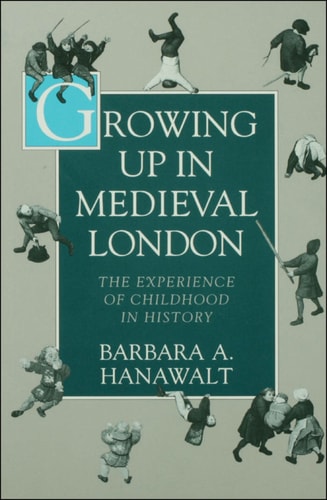
Growing Up in Medieval London: The Experience of Childhood in History
0
0
As an Amazon Associate and affiliate partner, Menrva Books earns from qualifying purchases. Learn more
Author Description
When Barbara Hanawalt's acclaimed history The Ties That Bind first appeared, it was hailed for its unprecedented research and vivid re-creation of medieval life. David Levine, writing in The New York Times Book Review, called Hanawalt's book "as stimulating for the questions it asks as for the answers it provides" and he concluded that "one comes away from this stimulating book with the same sense of wonder that Thomas Hardy's Angel Clare felt [:] 'The impressionable peasant leads a larger, fuller, more dramatic life than the pachydermatous king.'" Now, in Growing Up in Medieval London, Hanawalt again reveals the larger, fuller, more dramatic life of the common people, in this instance, the lives of children in London. Bringing together a wealth of evidence drawn from court records, literary sources, and books of advice, Hanawalt weaves a rich tapestry of the life of London youth during the fourteenth and fifteenth centuries. Much of what she finds is eye opening. She shows for instance that--contrary to the belief of some historians--medieval adults did recognize and pay close attention to the various stages of childhood and adolescence. For instance, manuals on childrearing, such as "Rhodes's Book of Nurture" or "Seager's School of Virtue," clearly reflect the value parents placed in laying the proper groundwork for a child's future. Likewise, wardship cases reveal that in fact London laws granted orphans greater protection than do our own courts. Hanawalt also breaks ground with her innovative narrative style. To bring medieval childhood to life, she creates composite profiles, based on the experiences of real children, which provide a more vivid portrait than otherwise possible of the trials and tribulations of medieval youths at work and at play. We discover through these portraits that the road to adulthood was fraught with danger. We meet Alison the Bastard Heiress, whose guardians married her off to their apprentice in order to gain control of her inheritance.
Menrva's Summary
THE THESIS
How did the social, legal, and familial structures of fourteenth and fifteenth-century London shape the lived experience of childhood? Barbara A. Hanawalt, a noted historian of medieval social life, utilizes a diverse array of primary sources to challenge the historical assumption that medieval adults were indifferent to the developmental stages of youth. By synthesizing court records, pedagogical manuals, and literary evidence, she constructs a framework that illustrates how medieval society actively invested in the upbringing and protection of its children.
THE SCOPE MAP
What You Will Find
- Analysis of fourteenth and fifteenth-century London social structures.
- Examination of legal protections for orphans and wardship cases.
- Integration of pedagogical advice manuals like 'Rhodes's Book of Nurture'.
- Use of composite biographical profiles to illustrate daily life, labor, and play.
THE AUTHORITY PERSPECTIVE
Scholars and historians recognize this work as a significant contribution to the study of medieval social history due to its innovative use of composite narratives. Readers frequently note the balance between rigorous archival research and the accessible, human-centered approach to historical reconstruction.
Page Count:
309
Publication Date:
1995-01-01
Publisher:
Oxford University Press
ISBN-10:
0199879974
ISBN-13:
9780199879977
History
London England
Childhood Studies
London History
Social History
European History
Community Tags
Similar Books